The majority of the postwar California furniture designers found inspiration in free-form biomorphic shapes with forward-looking parabolic forms utilizing experimental materials, designer Dan Johnson (1918-1979) was an exception. While Johnson’s earlier furniture pieces (late 1940s) looked more familiar, with folded planes of wood, blocky modern forms, and integrated pulls, his style drastically shifted after moving to Rome in the mid-1950s. Opening Dan Johnson Studio, he began creating pieces marked by their elegant sculptural form, looking back to Roman antiquity to find inspiration. Working in cast bronze, Johnson designed a series of spectacular sculptural pieces, his most well-known being the Gazelle chair. This mid-century silhouette combines function with a rare curvilinear shape. The graceful Gazelle chairs and tables were likely inspired by the animals depicted in early Roman hunting scenes. Johnson later wrote to a friend, that he is taking “a modern approach to the ancient Roman stuff I appreciated so much.”
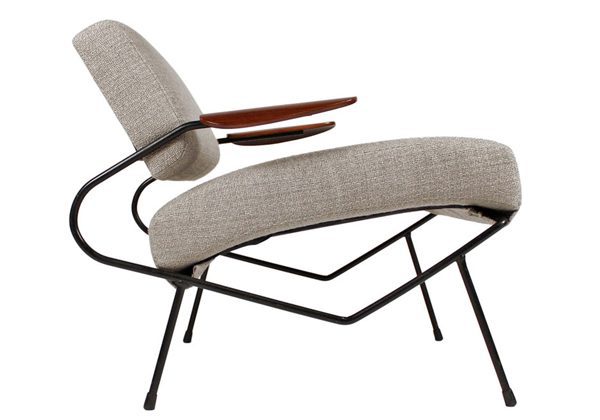
This early rare Dan Johnson lounge chair utilizes an iron frame and steam-bent walnut plywood armrest to create an elegant shape, c. early 1950s.
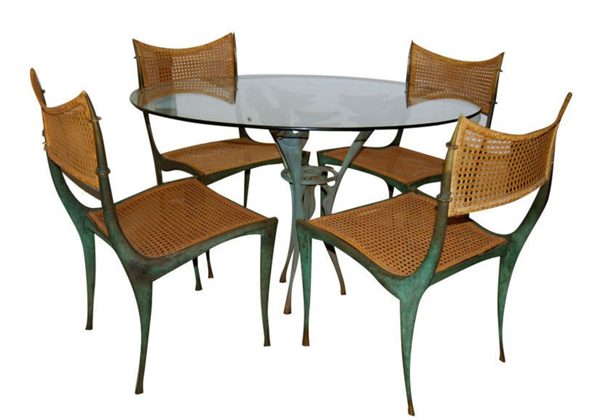
Inspired by Johnson’s residency in Rome, this Satyr table and four Gazelle chairs are a truly fantastic set. Cast in bronze with cane seats and backs, the blue-green patina and aged finish show the influence of his connection to the past. If you’re looking for more great vintage outdoor furniture don’t miss the work of designer to the stars William Haines.
Swiss architect and designer Pierre Jeanneret (1896 – 1967) collaborated with his well-known cousin Charles Edouard Jeanneret (aka Le Corbusier) for about twenty years. Pierre Jeanneret was brought on to design the furniture for India’s city of Chandigarh, at the urging of Le Corbusier (who was the project’s architect). Chandigarh was a new modern model of a city conceived by Jawaharlal Nehru, India’s first prime minister. Nehru’s intention for Chandigarh (named for Chandi, Hindu goddess of power) was to create a city that would “be a new town, symbolic of the freedom of India, unfettered by the traditions of the past.” Le Corbusier was hired to create a master plan for the city, and it was to become his largest and most ambitious project, involving residential, commercial, industrial areas, parks and a complex of government buildings. Jeanneret designed furniture for the entire project, using inexpensive locally-sourced bug and humidity resistant teak. During his partnership with Corbusier, Jeanneret also worked with Charlotte Perriand and they joined forces with Jean Prouvé in 1940 to research the potential of prefabricated housing. Jeanneret, sympathizing with the Communists, joined the French resistance, while Corbusier’s authoritarian leanings let him to elicit work from the Vichy Government and Italian Fascists. Jeanneret, inspired by the local traditional craftsmanship “cobbled together” rudimentary, yet ingenious furniture with bamboo sticks, iron rods, rope, can and straps. Eventually, he created more evolved “low-cost” furniture pieces, classified according to their leg shape, “V, X, Y and Z.” Most pieces were held together with two screws, and sometimes no screws at all. Jeanneret developed pieces for Knoll International, however, it was his time in Chandigarh that most profoundly affected him.

Jeanneret’s Office Chairs c. 1956, showcase his upside down “V” leg design. The chair is constructed of teak with a cane seat and backrest that seems to float in space.

The Committee Armchair, c. 1953, a more elegant chair in teak and leather with detached armrests and rounded cuffs and “V” leg design. All the leather used in the Chandigarh project was from cows that died of natural causes.
Berlin-born designer Erich Dieckmann (1896-1944) is one of the most important furniture designers of the Bauhaus. Much like Marcel Breuer, Dieckmann experimented with steel tubing and its application in the design of furniture – however, he is primarily known for his pieces in wood. In 1921, he enrolled at the Bauhaus in Weimar and between 1921-1925, he served an apprenticeship there as a carpenter. Erich Dieckmann’s designs for seating pieces are strictly geometric, consisting of frames based on right angles and curves which were virtually square or circular in cross-section. Another typical feature of his work is linking armrests and chair legs in a runner construction. Dieckmann used quality hardwoods, beech, cherry, oak and ash as well as rattan and cane matting which moderated the austere geometry of the pieces. Standardization of construction was emphasized to keep the prices of these mass-produced pieces as low as possible.
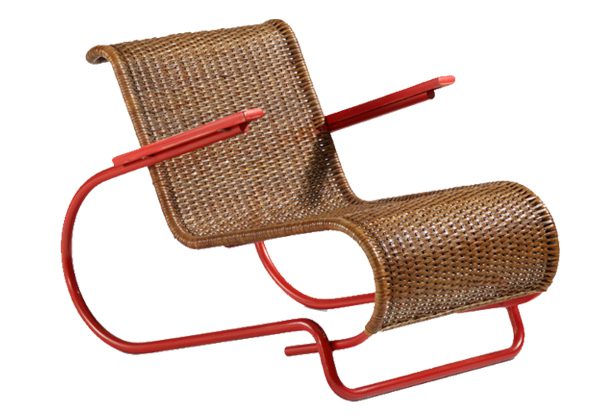
A rare Dieckmann creation c. 1930, this custom armchair was ordered by Adriaan Roland Holst from Sloterdijjkm, The Netherlands. Consisting of a painted tube steel construction, with a wicker seat and back and lacquered wood armrests. This rare armchair is currently up for auction.
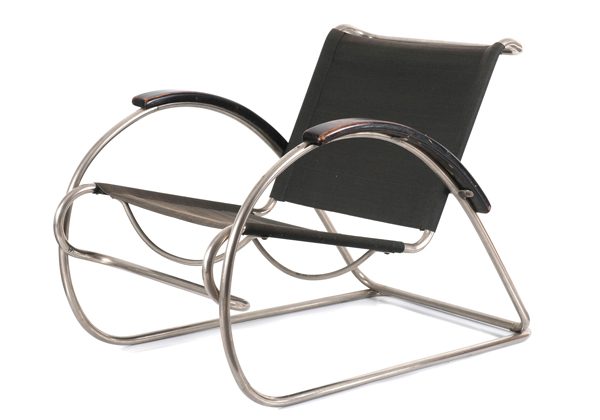
Another prime armchair, c. 1931 showcasing Dieckmann’s style of linking armrests with chair legs in a runner manner. The nickel-plated tubular steel boasts a black stretched canvas fabric back and seat with stained beech wood armrests, was originally manufactured for Cebaso, Ohrdruf.
Designer Illum Wikkelsø, one of the lesser known Danish designers, crafted rich, organic Scandinavian pieces in the 1950’s and 60’s. Following the path of most Danish designers at the time, Wikkelsø studied cabinetry, graduating from the Copenhagen School of Arts & Crafts. He held positions with cabinetmaker Jacob Kjaer and the firm of Peter Hvidt and Orla Molgaard-Nielsen. In 1944, Wikkelsø moved to Arhus to work as an interior designer until becoming an independent force in furniture design in 1954. After moving his studio to an idyllic two-century-old farmhouse in a small village south of Arhus in the late 1950’s, Wikkelsø designed his signature furniture pieces. Inspired by the natural forms in the Danish landscape, working with teak and rosewood, he captured delicately sculptural forms with a profound understanding of materials and superb attention to detail. Wikkelsø believed that furniture should be built to last while cradling the body and being pleasing to the eye. He went on to design furniture for some of the top Danish furniture makers, receiving several awards for his work.

This sculptural lounge chair c. 1960’s, showcases Wikkelsø’s playful details, with the chair bending slightly backwards in order to make the perfect angle to relax. The crossed legs, crafted in oak are typical of Wikkelsø’s craft and was manufactured by Mikael Laursen in Denmark.
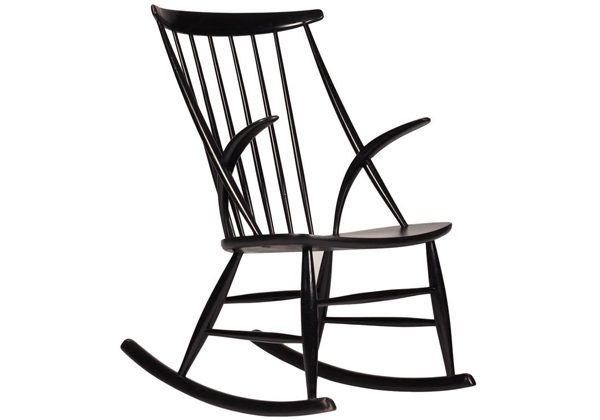
An amazing Scandinavian Modern rocking chair in ebonized wood. This model IW3 was designed by Illum Wikkelsø in 1958 for the maker Niels Ellersen.
Danish designer Poul Kjaerholm began his creative career as a cabinetmaker’s apprentice and continued his studies at the Danish School of Arts and Crafts in Copenhagen in 1952. While studying under masters Hans Wegner and Jørn Utzon (an industrial designer and architect of the Sydney Opera House) he honed his use of industrial methods and materials and brought a fresh, graceful approach to Danish modern design. Kjaerholm embraced the use of steel, rather than wood for framing his chairs and tables, unlike most of his Danish counterparts. He chose to incorporate other natural materials in his pieces, wood, leather, cane and marble to soften the steel forms.
From the mid-1950’s he worked for Ejvind Kold Christiansen, a friend and entrepreneur who gave Kjaerholm tremendous artistic freedom to produce a sleek extensive range of furnishings. Kjaerholm married Hanne (Kjaerholm) who became a successful architect, the pair being a Danish power design couple. Kjaerholm’s designs can be found as part of the collection in the Museum of Modern Art as well as the Victoria and Albert Museum in London, as well as throughout many museums in Denmark, Norway, Sweden and Germany. Since 1982 the Republic of Fritz Hansen has been producing a wide range of his products to his exact specifications.
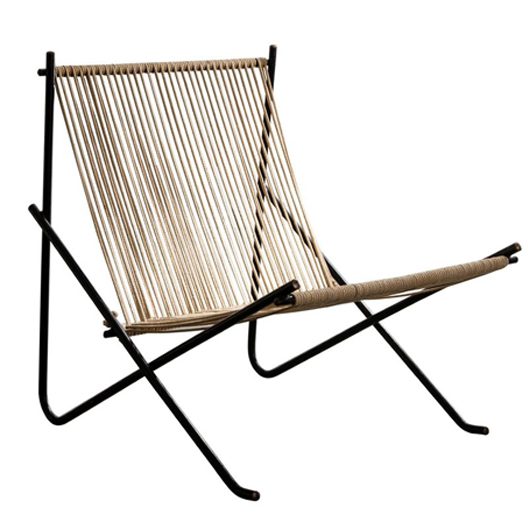
The extremely rare Holscher Chair c. 1953, named for Svend Holscher, (a blacksmith in the town of Rødby and father of friend Knud), is an example of Kjaerholm’s innovative construction techniques. The steel tube frame, manufactured by Holscher, supports the seat and back constructed of halyard wrapped by Hanne and Poul Kjaerholm. These chairs were only manufactured for the Kjaerholm family and friends. 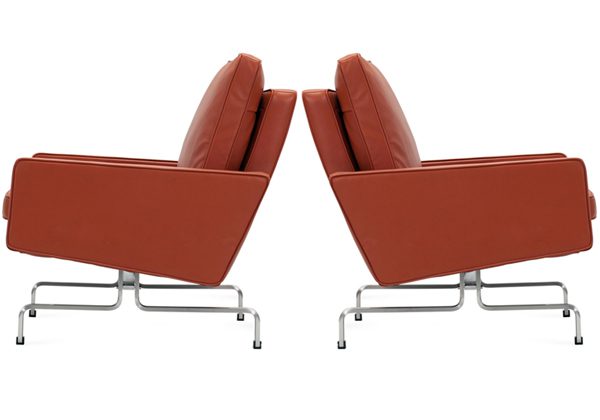
Independent and self-taught Hungarian designer, Mathieu Matégot (1910-2001) spent most of his life living and working in his beloved Paris, where he settled after finishing his studies at Budapest’s School of Art and Architecture in 1937. Signing up as a volunteer for the French Army, Matégot was captured and held prisoner in Germany until his escape in 1944. It was during this time of incarceration while working in a plant manufacturing mechanical accessories he was able to learn about sheet metal techniques. He later named this technique “Rigitulle” where metal tubing, combined with perforated metal sheet takes on the characteristics of fabric. “Rigitulle” could be bent, folded, shaped to give the objects he created a sense of transparency and weightlessness.
Matégot traveled the world in search of inspiration and industrial processes, bringing the inspiration home to interpret and create his own designs. In the 1950’s he devoted most of his time to the design of furniture and interior accessories. To ensure quality in the production of his products, Matégot set up two workshops, one in Paris and a second in Casablanca, Morocco. He created handcrafted furniture and decorative accessories using a variety of materials such as metal, rattan, glass, Formica and perforated sheet metal. Two of his most well-known pieces are the three-legged “Nagasaki” chair (1954) and the “Copacabana” armchair (1955/56, shown below). At the beginning of the 1960’s Matégot abruptly changed his focus to tapestry design, which he would continue for the rest of his career.
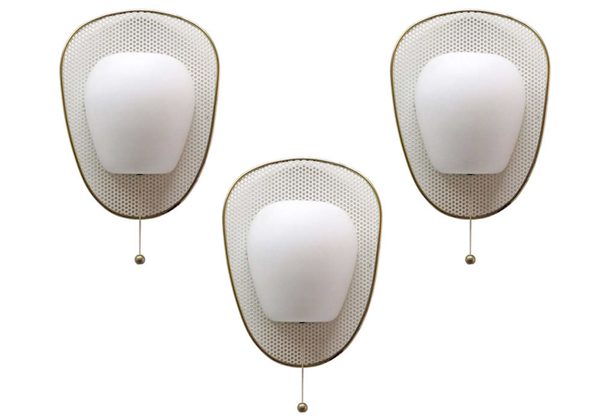
This trio of French wall sconces c. 1950’s, showcases Mathieu Matégot’s signature Rigitulle technique. Constructed of an enameled perforated metal shield with a brass rim and opaline glass shell, they are a combination of function and whimsy.

 The Copacabana lounge chair, c. 1955/56 consists of an organic tubular frame surrounding the round seat with a back made of perforated sheet metal. Another example of Matégot’s innovative Rigitulle technique. This chair is included in the design collection at the Museum of Deoratives Arts in Paris, at the Georges Pompidou Centre, and the National Museum of Modern Art. The chair is available as a re-issue today and still looks timeless and classic.