Pierre Koenig Architecture: Iconic Los Angeles Buildings That Defined an Era
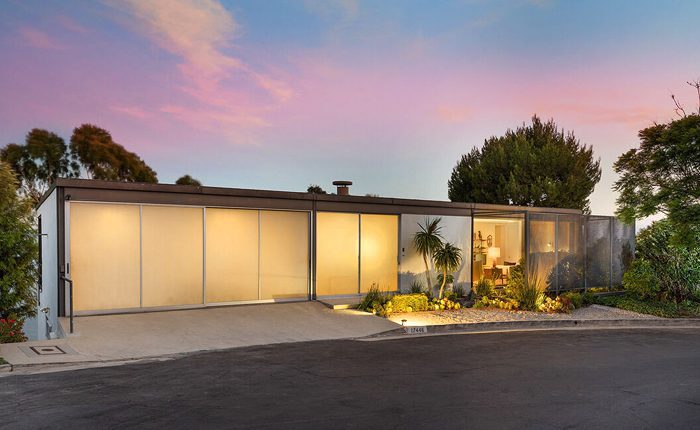
Pierre Koenig (1925–2004) was an American modernist architect based in Los Angeles, California. Born in San Francisco and raised in the Los Angeles suburb of San Gabriel, Koenig earned his Bachelor of Architecture from the University of Southern California (USC) in 1952 and established his private practice the same year. He is best known for designing two houses in the Arts and Architecture Case Study House program: Case Study House #21 (Bailey House, 1958) and Case Study House #22 (Stahl House, 1960), both located in the Hollywood Hills, Los Angeles, CA. His signature style combined prefabricated steel frames, expansive glass walls, open floor plans and seamless indoor-outdoor integration. Koenig taught at the USC School of Architecture from 1964 until his death and completed approximately 43 buildings over his career. He was elected AIA Fellow in 1971 and named an Honorary Fellow of the Royal Institute of British Architects in 2000. His archive is held at the Getty Research Institute, Los Angeles, CA.
Pierre Koenig – Architect Profile
- Born: October 17, 1925 — San Francisco, California
- Died: April 4, 2004 — Los Angeles, California (age 78)
- Education: B.Arch, University of Southern California (USC), 1952. Previously attended Pasadena City College and the University of Utah
- Style: California Modernism, Structural Expressionism, Mid-Century Modern; Steel-and-glass residential architecture with an emphasis on industrial materials, open planning and indoor-outdoor integration
- Known For: Pioneering prefabricated steel-frame residential construction in Southern California; designing Case Study Houses #21 (Bailey House) and #22 (Stahl House); 40 years of teaching at the USC School of Architecture; building approximately 43 completed structures over his career
- Key Project Locations: Hollywood Hills, CA – Brentwood, Los Angeles, CA – Glendale, CA – La Cañada Flintridge, CA – Rustic Canyon, Santa Monica, CA -Malibu, CA.
- Notable Work: Case Study House #21 (Bailey House), 1958; Case Study House #22 (Stahl House), 1960; Koenig House #1, 1950; Koenig House #2, 1985; Schwartz House, 1994; LaFetra Beach House, 2012 (completed posthumously)
- Influences: Raphael Soriano, Ludwig Mies van der Rohe, Rudolph Schindler, Edward Fickett
- Awards and Honors: AIA Fellow (FAIA, 1971); Honorary Fellow, Royal Institute of British Architects (RIBA, 2000); USC Distinguished Alumni Award (1998); USC Distinguished Professor (1998); AIA Los Angeles Gold Medal (1999); AIA “House and Home” Award of Merit (1960)
- Archive: The Pierre Koenig Papers and Drawings (1925–2007) are held at the Getty Research Institute, Los Angeles. The collection includes drawings, photographs, client correspondence, project records and three architectural models spanning his full 50-year career.
For architecture enthusiasts, design professionals and buyers seeking an architecturally significant property, Koenig’s legacy is essential. His work remains highly sought after in today’s real estate market and his influence continues to shape how we think about modernist living in Southern California. Explore our curated collection of architectural homes for sale in Los Angeles to discover properties inspired by this remarkable tradition.
In This Article
- Who Was Pierre Koenig?
- The Case Study House Program
- The Stahl House: Case Study House #22
- Case Study House #21 and the Bailey House
- Koenig’s Design Philosophy and Use of Steel
- Other Notable Koenig Projects in Los Angeles
- The Legacy and Influence of Koenig’s Work
- Buying a Modernist Home in Los Angeles Today
- FAQs About Pierre Koenig Architecture
Who Was Pierre Koenig?
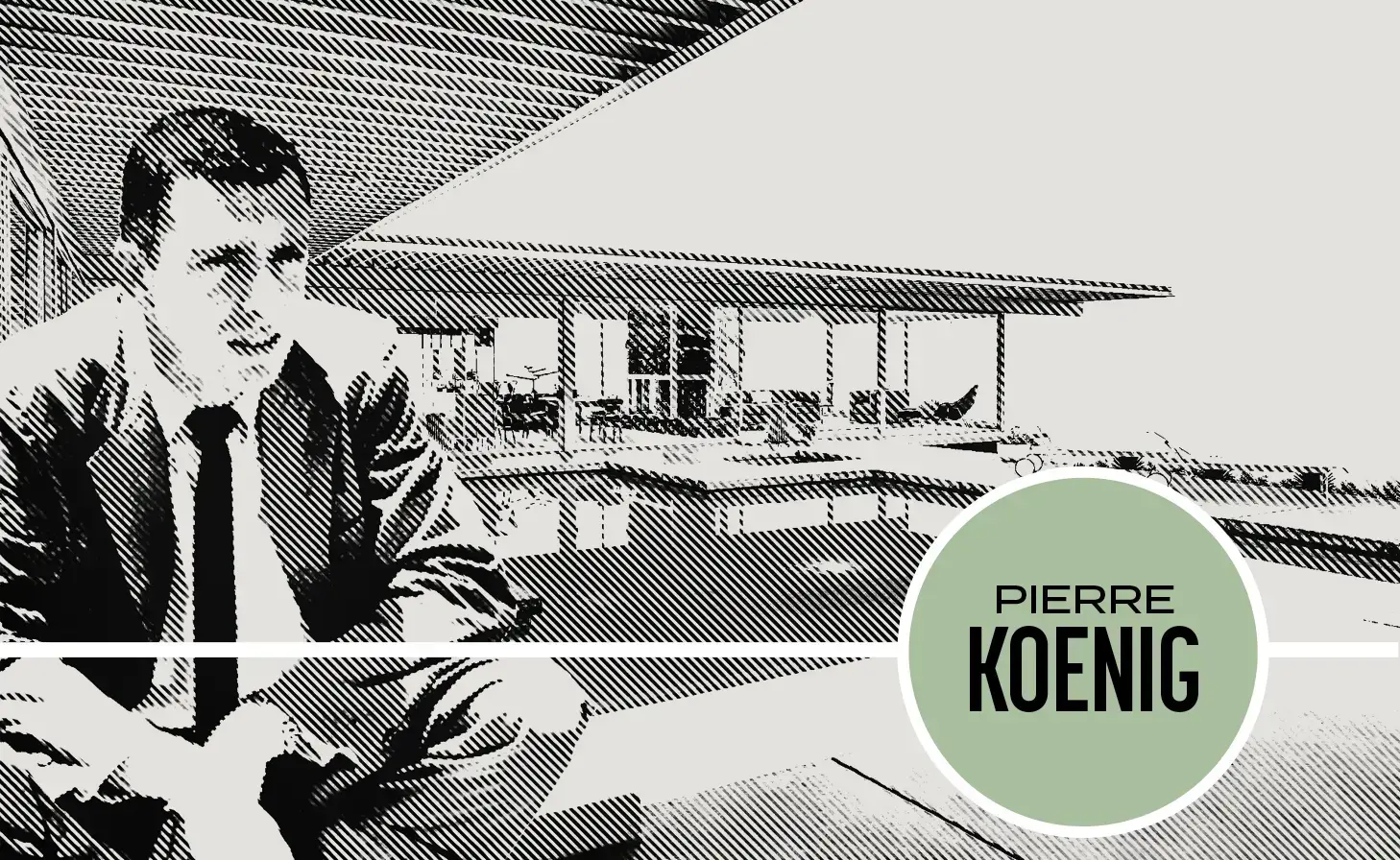
Pierre Koenig, architect, kneeling in front of The Stahl House (Case Study 22) in Los Angeles. His rigorous, systematic approach to steel-frame construction set him apart from his contemporaries in the Case Study House program. The hillside sites of Los Angeles became Koenig’s canvas for architectural experimentation. Steel beams stretch outward over steep terrain, creating homes that hover above canyons and city lights. Each project reveals his fascination with structure, balance and daring geometry.
Pierre Koenig was born in San Francisco in 1925 and studied architecture at the University of Southern California, where he would later spend decades teaching and shaping the next generation of architects. His formal training was interrupted by military service in World War II, which only deepened his respect for engineered precision and industrial materials. When he returned to his studies, he was already committed to a vision of architecture built from steel, glass and honest structure.
Unlike many of his peers who gravitated toward wood-frame construction or the softer vocabularies of organic modernism, Koenig was drawn to the clarity of industrial building methods. He believed that the technologies used in factories and bridges could and should be applied to residential architecture. His student thesis project was already a steel-framed house, a radical proposition at a time when most single-family homes were still built from wood and stucco.
Koenig’s dedication to his principles was unwavering throughout his career. He continued designing, teaching and experimenting well into the 1990s and early 2000s. He passed away in 2004, leaving behind a body of work that continues to inspire architects, collectors and homeowners across Los Angeles.
The Case Study House Program
Pierre Koenig’s contribution to Los Angeles architecture began with the Case Study House program, which launched him to international recognition. Conceived by Arts and Architecture magazine editor John Entenza in 1945, the program commissioned leading architects to design and build model homes using modern materials and construction methods. The goal was ambitious: demonstrate that good design and good living could be affordable and practical for ordinary Americans returning from war.
The program ran from 1945 to 1966 and produced 36 official Case Study House prototypes, though not all were built. Participating architects included some of the most celebrated names in American modernism: Charles and Ray Eames, Eero Saarinen, Craig Ellwood and Raphael Soriano, among others. The houses were photographed, published and opened to the public, making them both practical demonstrations and powerful cultural artifacts.
For an in-depth look at how this program shaped the Los Angeles we know today, the ArchDaily Case Study Houses archive offers an excellent overview of the project’s full scope. Koenig was one of the few architects to contribute two houses to the program and both became landmarks of mid-century modern design. Browse our guide to architectural home styles in Los Angeles to learn more about how the Case Study tradition fits into the broader story of Southern California modernism.
The Stahl House: Case Study House #22
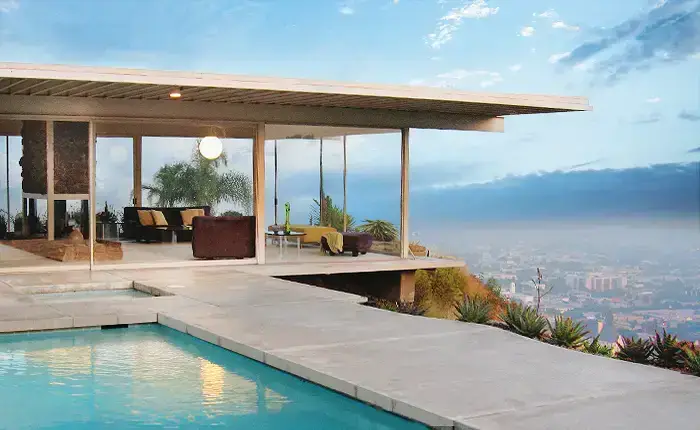
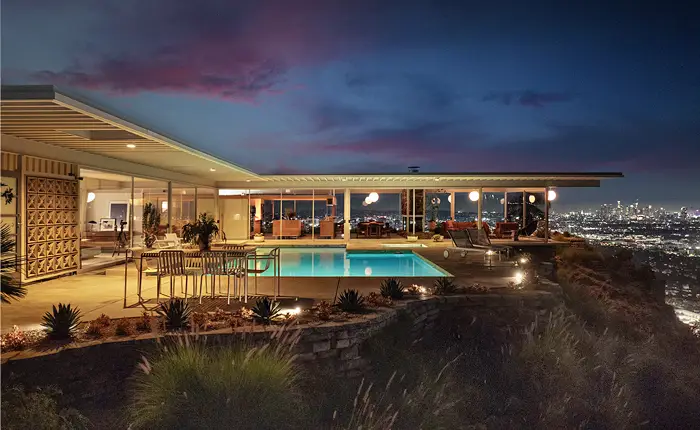
The Stahl House (Case Study House #22), completed in 1960. Julius Shulman’s iconic photograph of two women seated in the glass-walled living room, with the glittering city below, became one of the most reproduced architectural images of the 20th century. Perched dramatically above the city, the Case Study House No. 22 remains one of the most photographed homes in the world. Koenig’s steel frame forms a glass pavilion that seems to float above the lights of Los Angeles. Photo: Kim Hayden Holt.
No single building is more associated with Pierre Koenig’s architecture than the Stahl House, officially designated Case Study House #22. Completed in 1960 on a precarious hillside site in the Hollywood Hills, the house appears to float above Los Angeles in a breathtaking L-shaped plan of steel and glass. Its construction was itself a feat of engineering improvisation: Koenig used steel donated by the client, Buck Stahl, who had been collecting it on the lot for years in anticipation of building his dream home.
The genius of the Stahl House lies in how Koenig responded to a genuinely difficult site. The lot was narrow, steeply sloped and bounded by a dramatic cliff edge. Rather than treating these conditions as obstacles, Koenig used them as opportunities. The cantilevered steel roof extends dramatically over the canyon and the glass walls eliminate any sense of boundary between the interior and the panoramic view of the city stretching to the horizon.
The house became internationally famous through Julius Shulman’s 1960 photograph, which showed two elegantly dressed women in the glass-walled living room with the lights of Los Angeles spread out behind them. That image captured something essential about California modernism: the promise of a life lived openly, elegantly and in harmony with a remarkable landscape. The Stahl House is still privately owned and operated as an architecture tour destination, making it one of the few Case Study Houses the public can visit today.
Case Study House #21 and the Bailey House
Koenig’s first contribution to the Case Study House program came in 1958, two years before the Stahl House. Case Study House #21, known as the Bailey House, was built in the Laurel Canyon neighborhood of Los Angeles for Walter and Mary Bailey. Where the Stahl House is celebrated for drama and spectacle, the Bailey House demonstrates a quieter mastery of proportion, light and domestic comfort.
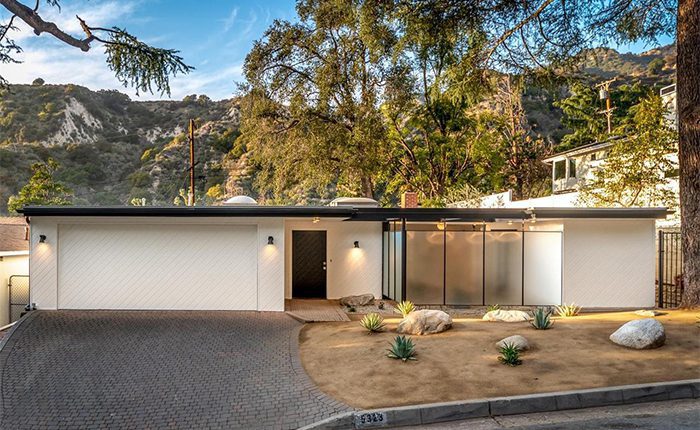
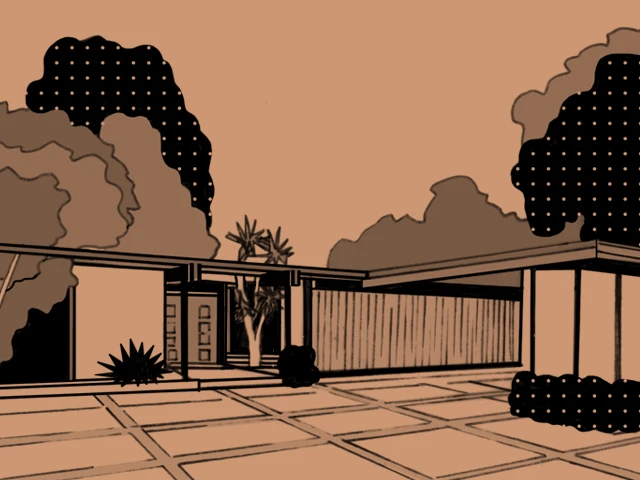
The Bailey House sits on a flat lot and uses a more straightforward rectangular plan. Koenig’s command of steel detailing and spatial organization is evident throughout. The roof plane extends beyond the glass walls to create shaded outdoor living areas, an essential feature for California’s warm climate. Interior spaces flow easily from one to the next, with an open kitchen and living area that anticipated the open-plan layouts that would become standard decades later.
The Bailey House has undergone careful restoration in recent years and remains a well-preserved example of Koenig’s residential work. Unlike the Stahl House, it exists in a quieter context, surrounded by trees and neighbors rather than perched above a cityscape. Together, the two Case Study houses demonstrate the range of Koenig’s ability: he could create iconic spectacle and refined domesticity with equal confidence. Our team at Beyond Shelter specializes in mid-century modern homes for sale in Los Angeles, including properties from this celebrated era of California design.
The Architecture of Each Case Study House
What makes both Koenig Case Study Houses architecturally significant goes beyond their individual beauty. Each house was designed as a demonstration project, intended to prove that high-quality, thoughtfully designed homes could be built efficiently and affordably using industrial materials. Koenig’s ability to achieve elegance within tight budgets and practical constraints is a central part of his legacy and it remains relevant to contemporary architects working today.
Koenig’s Design Philosophy and Use of Steel
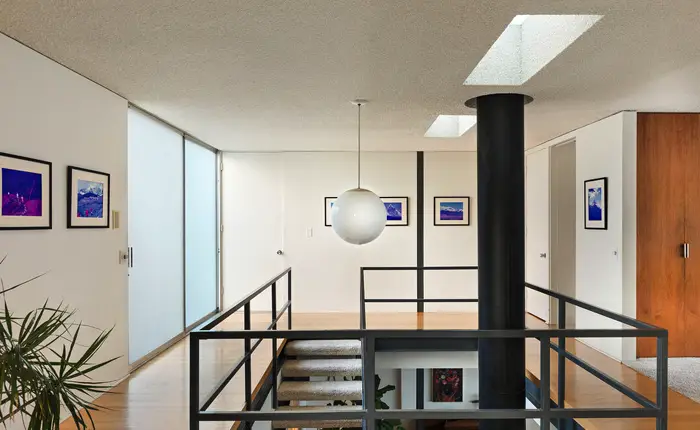
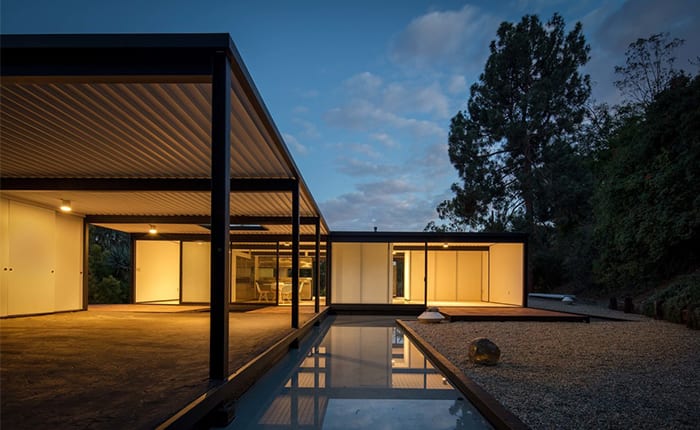
Koenig approached residential design with the mindset of an engineer and the vision of a modernist artist. Steel framing allowed him to reduce the structure to its thinnest, most elegant expression. His homes feel almost weightless; architecture suspended between sky and landscape. His insistence on exposed structural steel as an aesthetic element, not just a building method, was a signature of his work throughout his career.
Pierre Koenig’s commitment to steel was both philosophical and practical. Steel enabled him to achieve long spans with minimal structural support, allowing large expanses of uninterrupted glass and open floor plans free of load-bearing walls. The thinness of steel columns and beams gave his buildings a lightness and precision that wood framing simply could not match. Every structural element was carefully sized and detailed and Koenig made no effort to conceal his building systems. Instead, the structure became the architecture.
This approach aligned him with what is sometimes called the California School of structural expressionism, a tradition that valued honesty of materials and clarity of construction as aesthetic virtues in themselves. Koenig was deeply influenced by his USC colleague and mentor Raphael Soriano, who had pioneered steel-frame residential construction in Los Angeles in the 1940s. Koenig took those lessons and pushed them further, refining his detailing and expanding the scale of what was possible in a steel-framed home.
His teaching at USC reinforced these commitments. For decades, Koenig’s students encountered a professor who believed that architecture must be buildable, rational and structurally honest. He was skeptical of purely formal gestures and insisted that beauty in architecture emerged from solving real problems well. This rigorous, almost engineering-oriented mindset produced buildings that have aged remarkably well, both physically and in their relevance to contemporary design thinking.
Other Notable Koenig Projects in Los Angeles
While the two Case Study Houses are his most famous works, Pierre Koenig’s career extended across dozens of residential and institutional projects throughout Los Angeles and Southern California. His portfolio reveals a consistent design intelligence applied to a wide range of sites, budgets and programs. Several of these lesser-known houses are equally worthy of study and, in some cases, are available in today’s real estate market.
Among his other notable works is the Schwartz House in Santa Monica’s Rustic Canyon, a sprawling steel structure that demonstrates Koenig’s skill with larger-scale residential programs. The Johnson/ Riebe House in Carmel Valley, completed in 1962, shows how he adapted his approach to the Northern California context, with its varied landscape conditions and client needs. In each case, the same principles apply: exposed steel structure, maximum glass, open planning and a careful response to site and climate.
Later in his career, Koenig returned to the Case Study House program in spirit if not in name, designing new steel-and-glass houses in the 1980s and 1990s that demonstrated his continued engagement with the principles he had developed decades earlier. These later works are sometimes overlooked but deserve attention as evidence of a mature architect who never stopped exploring. For buyers interested in the full range of Los Angeles architectural history, our team offers guidance on exploring Los Angeles neighborhoods with strong concentrations of significant modernist architecture.
The Legacy and Influence of Koenig’s Work
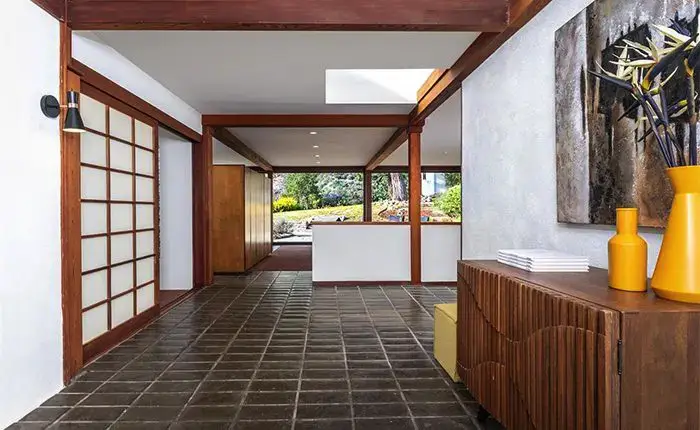
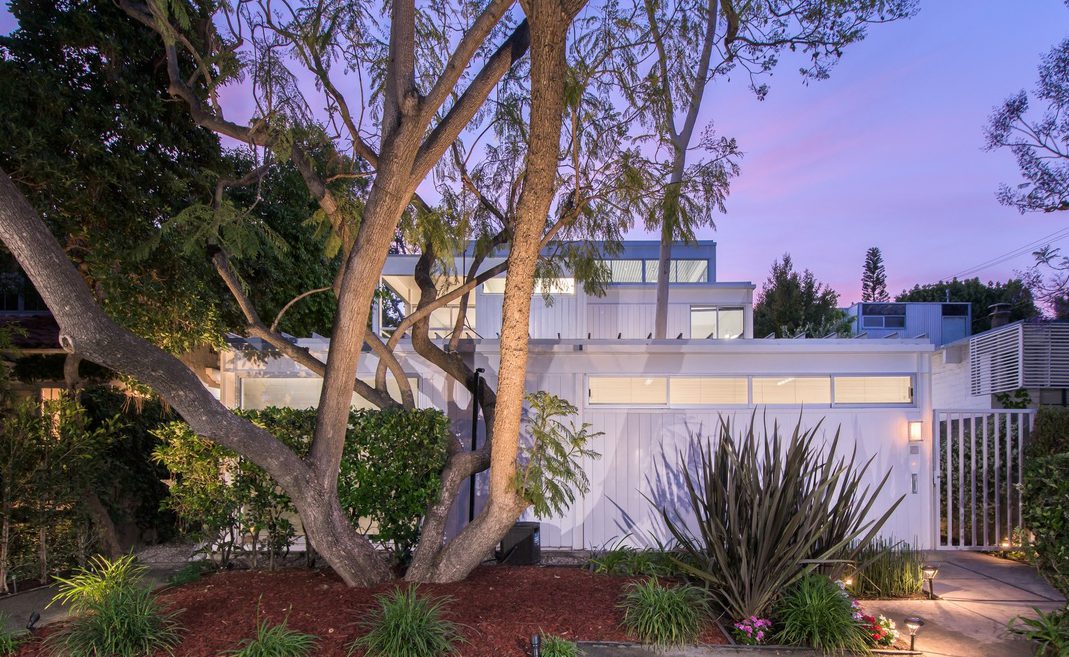
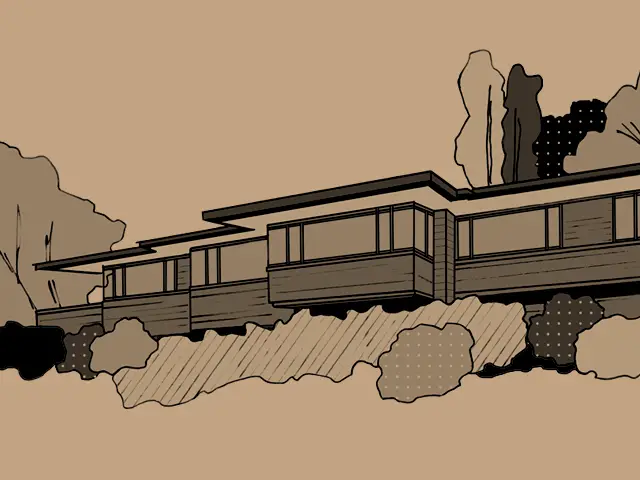
The influence of Pierre Koenig’s hillside modernism continues to shape contemporary residential design in Los Angeles. Steel-and-glass pavilions overlooking the city remain among the most sought-after architectural property types in the region. Koenig’s work captured the spirit of postwar California, innovative, optimistic and forward-looking. The interior of this modern hillside Los Angeles home is showcases the architects’ interest in Japanese design.
The influence of Pierre Koenig on architecture extends well beyond the buildings he designed. Through his teaching at USC, he shaped generations of architects who went on to practice throughout Southern California and beyond. His insistence on structural honesty, material discipline and a response to climate and site established a framework for thinking about California modernism that remains vital today.
His work has also had an outsized influence on popular culture. The Stahl House has appeared in films, television shows, advertisements and countless editorial features. It has become one of the defining images of Los Angeles itself: a city of light, glamour and confident modernity. That image-making power says something important about the relationship between architecture and cultural identity and about how a single building can come to represent an entire way of life.
Contemporary architects working in Los Angeles continue to connect with Koenig’s legacy. Some embrace it directly, designing steel-and-glass homes that explicitly reference his vocabulary. Others absorb his lessons more quietly, applying his principles of structural clarity and spatial openness in new materials and forms. Either way, his presence in the Los Angeles architectural conversation is inescapable. The Dezeen archive on Pierre Koenig offers a useful survey of how contemporary critics and historians have assessed his enduring influence.
Buying a Modernist Home in Los Angeles Today
For buyers drawn to Pierre Koenig’s architecture, the Los Angeles real estate market offers a few rare opportunities to purchase. From mid-century modern properties with documented architectural provenance to later homes built in the Case Study tradition, a few of Koenig’s design-forward properties come to market from time to time. Working with advisors who understand both the architectural significance and the real estate value of these properties is the best place to start if acquiring one of Pierre Koenig’s homes is your goal.
Purchasing a modernist home in Los Angeles involves considerations that go beyond the standard real estate transaction. Steel-and-glass homes require specific maintenance expertise. Historic properties may carry preservation designations that affect what alterations are permitted. Hillside homes bring additional structural and access considerations. And the cultural cachet of an architecturally significant property creates a unique market dynamic that rewards buyers who are well-informed about what they are acquiring.
Beyond Shelter’s team combines deep architectural knowledge with comprehensive real estate expertise, making us uniquely positioned to guide buyers through this specialized market. Whether you are seeking a mid-century modern classic, a Case Study-era landmark, or a contemporary home inspired by the modernist tradition, we have the knowledge and network to help you find and acquire the right property. Visit our Los Angeles real estate team page to learn more about how we work, or contact us directly to discuss your search.
Pierre Koenig – Notable Projects and Houses
- Koenig House #1 (1950) — Glendale, CA. Koenig’s first steel-frame residence, built while still a student at USC, at a cost below comparable wood-frame construction, 1,000 sf. Won the AIA “House and Home” Award of Merit. Disassembled in the early 1970s for the expansion of the Glendale 2 Freeway.
- Lamel House (1953) — Glendale, CA. One of Koenig’s earliest client commissions after graduation; 1,200 sf steel-and-glass residence that established the formal language he would refine in the Case Study Houses. Still standing as of 2024.
- Squire House (1953) — La Cañada Flintridge, CA. Early steel-and-glass residence with ribbed-steel ceilings and open carport; a direct prototype for the structural system and material palette of the Case Study Houses. Structural engineer: William Porush.
- Scott House (1953) — Tujunga, CA. Steel-frame residence with 1,250 sf interior and 816 sf covered porch; built by structural engineer William Porush. Restored and available for short-term rental as of 2014.
- Burwash House (1958) — Tujunga, CA. Steel-and-glass residence; 1,250 sf. One of several houses Koenig designed in the foothills northeast of Los Angeles during his most productive early period. Structural engineer: William Porush.
- Case Study House #21 (Bailey House) (1958) — Hollywood Hills, Los Angeles, CA. Designed for Walter and Mary Bailey; 1,320 sf built for $20,000. Steel-and-glass pavilion on a north-south axis to maximize winter sun and minimize summer heat. Praised by Arts & Architecture as “some of the cleanest and most immaculate thinking in the development of the small contemporary house.” Sold at auction in 2006 for $3.1 million.
- Case Study House #22 (Stahl House) (1960) — Hollywood Hills, Los Angeles, CA. Commissioned by Buck Stahl; 2,600 sf plus 1,500 sf covered areas. Cantilevered L-plan of steel and glass perched above the city on a site other architects had refused. Immortalized by Julius Shulman’s 1960 photograph, widely considered the definitive image of California modernism. Still owned by the Stahl family.
- Seidel – Hagen House (1960) — Mandeville Canyon, Los Angeles, CA. Steel-frame residence with multiple additions overseen by Koenig over three decades, demonstrating his long-term relationships with clients and his commitment to the integrity of his buildings over time.
- Seidel – Hagen Beach House (1961) — Malibu, CA. Steel-and-glass beachfront residence on the Pacific Coast Highway; an early example of Koenig applying his vocabulary to a coastal site with direct ocean exposure.
- Wilheim Renovation (1961) — Brentwood, Los Angeles, CA. Residential renovation; 1,800 sf. Built by Seidel Associates. Featured in Modern Magazine, 2017.
- Johnson House (1962) — Carmel Valley, CA. One of Koenig’s largest and most refined residential commissions, 3,800 sf. Photographed by Julius Shulman and Juergen Nogai. Featured in GA Houses 54. Restored and expanded by Koenig himself between 1990 and 1995.
- Oberman House (1962) — Rancho Palos Verdes, CA. Steel-and-glass hillside residence with views over the Pacific; an important example of Koenig’s work outside the Hollywood Hills during his most prolific decade.
- Beagles House (1963) — Pacific Palisades, CA. Hillside residence with panoramic ocean views from the Palisades to Palos Verdes; described as remaining in pristine original condition. One of Koenig’s most intact surviving works from the early 1960s.
- Chemehuevi Prefabricated Housing (1971–1976) — California. A complex of prefabricated structures for the Chemehuevi Native American community, one of the few non-residential projects in Koenig’s portfolio and a demonstration of his lifelong commitment to affordable prefabricated construction.
- Gantert Residence (1983) — Los Angeles, CA. One of only a handful of projects completed during Koenig’s relatively quiet period of the 1970s and early 1980s, when postmodernism dominated the architectural conversation and his rigorous structural approach found few clients.
- Koenig House #2 (1985) — Brentwood, Los Angeles, CA. Koenig’s own three-story steel-and-glass residence on a 40-foot-wide lot, designed for himself and his wife Gloria. A demonstration of his continued commitment to Case Study principles four decades after his first house.
- Schwartz House (1994–1996) — Rustic Canyon, Santa Monica, CA. One of Koenig’s most ambitious late-career residential commissions, the last of his designs completed during his lifetime. Featured in GA Houses 44.
- Ressner Renovation and Addition (2001) — Brentwood, Los Angeles, CA. Renovation and addition to a 1947 residence adjacent to Koenig House #2; one of his final realized projects.
- LaFetra Beach House (2012, completed posthumously) — Malibu, CA. Commissioned in 2000; Koenig died before its completion. Finished by architect James Tyler, Koenig’s chosen successor. Two-story steel-and-glass beachfront residence; 4,080 sf. Koenig described its views as rivaling those of the Stahl House.
Frequently Asked Questions About Pierre Koenig Architecture
Looking for a Pierre Koenig Home for Sale in Los Angeles?
Pierre Koenig’s vision of elegant, open, light-filled living is alive in today’s Los Angeles real estate market.
Whether you are searching for a documented mid-century modern property, a Case Study-era home, or a contemporary residence that carries the modernist tradition forward, Beyond Shelter has the architectural expertise and real estate knowledge to guide your search. We understand what makes these properties special, what questions to ask and how to evaluate both the architectural and market value of design-significant homes.
Browse Available Properties: Mid-Century Modern Homes for Sale in Los Angeles
Explore by Architect: Architectural Homes for Sale
Service Areas: Los Angeles and Southern California
About Beyond Shelter
Beyond Shelter is a premier architecture real estate group serving Los Angeles and Southern California. With deep expertise in modernist architecture, historic preservation and architectural history, we help clients discover and acquire architecturally significant properties. Our team combines architectural knowledge with real estate expertise to provide comprehensive guidance for design-conscious buyers, sellers and architecture enthusiasts.