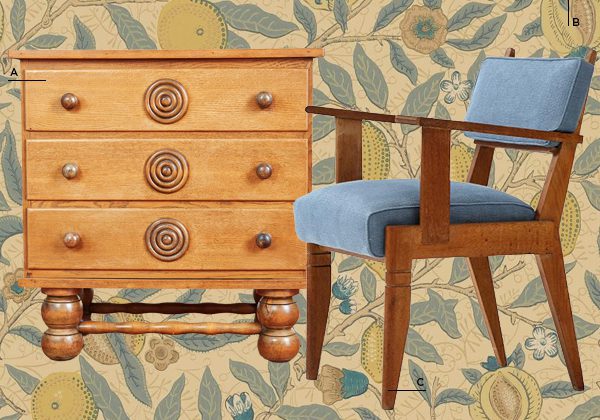
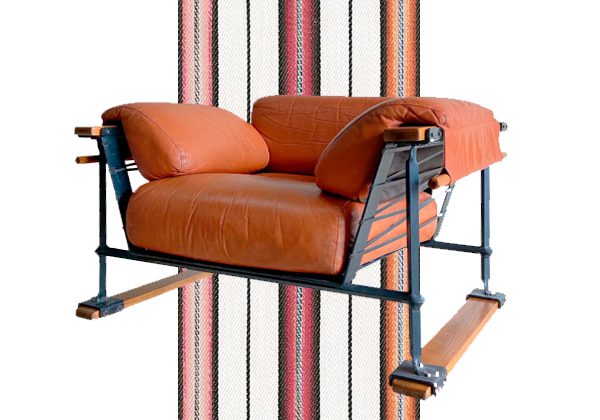
Pierre Chareau (1883–1950), a French architect, interior and furniture designer born in Bordeaux, France attended the École des Beaux-Arts in Paris from the age of 17 to a family of shipbuilders. Together with Le Corbusier, Pierre Chareau was one of the first modern architects of France to experiment with new materials such as glass and steel. His major architectural work and Modernist landmark, the Maison de Verre (1928-1931) in Paris, consists of three floors, with a central courtyard – its metal frame structure supported framed panels of glass. The rooms were separated by wood or metal closet doors that slid or rotated, while the structural elements remained visible, transforming the house’s functional elements into decorative ones – the house was conceived as a total space. Although trained as an architect, Chareau’s primary interest was furniture design. Pierre Chareau’s furniture was often dynamic – designed to perform multiple functions, pivoting, expanding, transformable. The influence of Neoplasticism, Cubism and De Stijl is seen boldly in his work. In 1939 Chareau, forced to leave Paris came to the United States and in the mid-1940s the artist Robert Motherwell commissioned him to design a small studio house in the Hamptons, demolished in 1985.
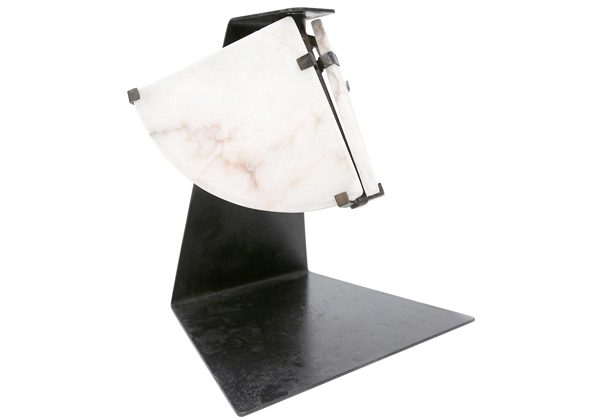
This important Chareau lamp, model LP 180, boasts 2 quarter circle alabaster shades atop a trapezoid plied metal base, c. 1923.
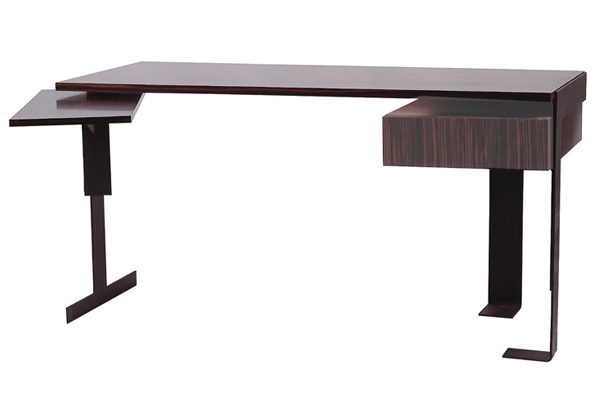
A play on contrasts, this Chareau desk combines his signature metal with precious woods, c. 1927.
A student of Ecole des Art Appliqués in Paris from 1939 to 1943, Roger Capron (1922-2006, France) was an internationally recognized designer. In 1946, Capron moved to Vallauris, where he founded a ceramics workshop known as ‘l`Atelier Callis’, contributing to the renaissance of ceramics in the area. In 1952, he opened a small ceramics factory and by 1957 he had established a considerable international reputation. A leading ceramicist of his era, Roger Capron pioneered various styles at his studio in Vallauris, France during the 1950s, 1960s and 1970s. Whether working on furniture, decorative or functional pieces, Capron imbues his design pieces with a whimsical spirit and flavor.

“Soleil” Tile Wall Sculpture c.1971. This decorative wall sculpture made in a patchwork of sandstone stamped elements in a fabulous range of sea blue, moss, white and taupe. Is a great example of the partnership between Capron and Jean Derval in the early 70s.
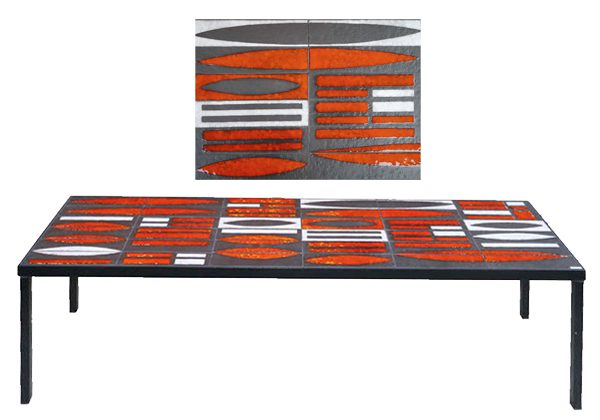
The “Ellipses” Tile Coffee Table c.1960s in black hammered ceramic tiles with rhythmic drawings in a matte-white and shiny red glaze.
Warren Platner, architect, furniture and interior designer is an icon of 1960’s Modernism. As a graduate from Cornell University in 1941 with a degree in architecture, he worked for some of the most prominent architectural practices in the country, including the iconic firms of Raymond Loewy, I.M. Pei, Eero Saarinen and Kevin Roche – before opening his own firm, Warren Platner Associates. In the mid-60s, while working in the firms of Saarinen and Roche, Platner unveiled his collection of chairs, ottomans and tables, known as the Platner Collection. Produced by Knoll International, with the aid of a grant from the Graham Foundation, each piece rested on a sculptural base of nickel-plated steel rods resembling a “shiny sheaf of wheat. Production was complicated because the sculptural bases were made of hundreds of rods and for some chairs required more than 1,000 welds. An intricate cylindrical mesh steel base, creating a unique architectural play between the interior and exterior space, supported the upholstered seat. Platner designed other office furniture and was also involved in a number of large architecture and interior design commissions in which he was often responsible for details down to the dishes and textiles. One of Platner’s most well know interior projects was Windows on the World, which opened at the World Trade Center in 1976.
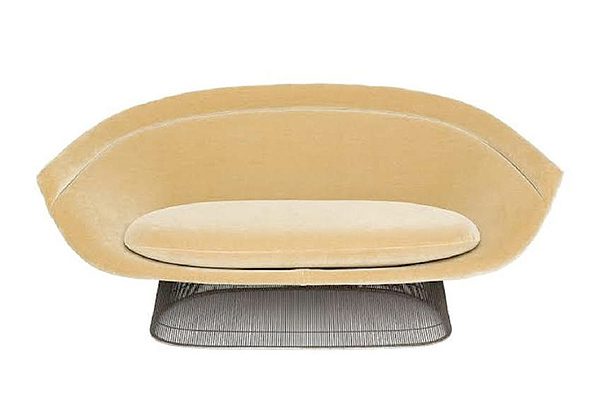
A rare Warren Platner Settee c.1968, only 50 of these were produced. This piece has not been re-issued by Knoll and is highly sought after.

Custom Warren Platner Rosewood Credenza c. 1972. Exceptional monumental book-matched Rosewood veneer and topped with a granite slab by Platner for Lehigh-Leopold.
Born in 1917, in Innsbruck Austria, Ettore Sottsass brought ironic wit, bold colors and contemporary styling to everyday objects. In 1958, he started to work with Olivetti as a design consultant for more than twenty years. In 1967, together with Fernanda Pivano and the poet Allen Ginsberg, he founded the magazine ‘pianeta fresco’. In the 1980’s he created the Memphis group of international postmodern designers and architects. This design collective is known for neon colors, odd, angled shapes, kitsch suburban motifs and laminate patterns containing squiggle graphics.
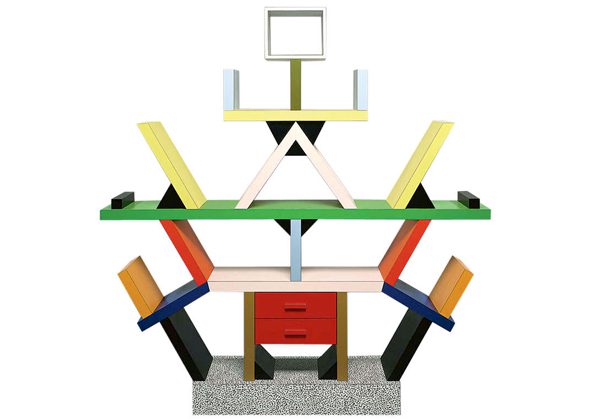
The Carlton book case c.1981. Boasts the classic Memphis movement elements, wood and plastic laminate constructed in an array of colors, unusual angles and whimsy.
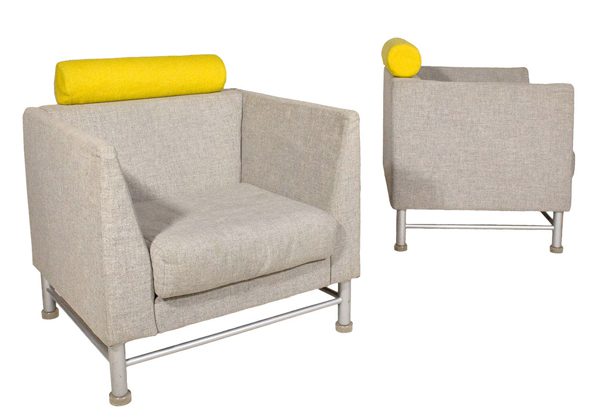
The ‘Eastside’ lounge chairs, c.1980 were commissioned by Knoll, in wool upholstery with metal frames.
Charlotte Perriand, born in Paris in 1903, is deemed one of the most important furniture designers of the mid 20th century. At the age of 24, she produced a number of critically acclaimed pieces of furniture constructed from anodized aluminium and chromium-plated steel that drew the attention of Le Corbusier and Pierre Jeanneret. She began a working relationship with them which lasted until 1937. They worked together to create buildings where the line between interior furnishings and the exterior form didn’t exist.
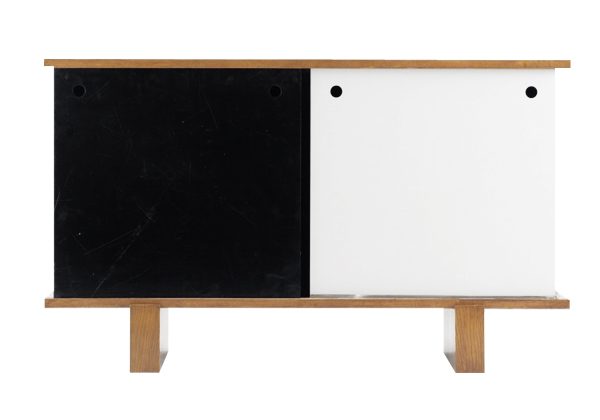
Perriand’s forward thinking Bloc Cabinet c.1958 is constructed of oak with two enameled steel doors which conceal three adjustable shelves.

In the 1960’s Charlotte Perriand was contracted to design and develop the French ski resort ‘Les Arcs’, emphasizing practical use of small spaces and open living plans. These tubular steel and leather chairs were designed for the project and became know as Les Arc chairs.
Following World War II, Robert Brown (Brown Jordan) sought to introduce a product utilizing reclaimed materials. Collaborating with well-known designer, Walter Lamb, these modern prototypes were crafted utilizing bronze and copper tubing salvaged from sunken naval ships at Pearl Harbor. Lamb’s’ signature ultra-cool curvy furniture pieces, lounge chairs, dining tables, benches and more, combine extruded metal frames with hand-wrapped, marine-grade, cording that is flexible enough to provide comfort but strong enough to withstand the elements. The bronze or copper frames do not rust and will develop a beautiful patina over time.
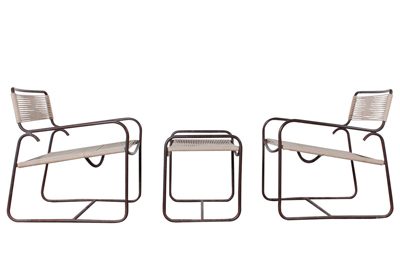
A signature pair of Lamb’s bronze lounge chairs with matching ottoman. Lamb’s collection for Brown Jordan is synonymous with cool California design and has been recognized with a MoMA design award.
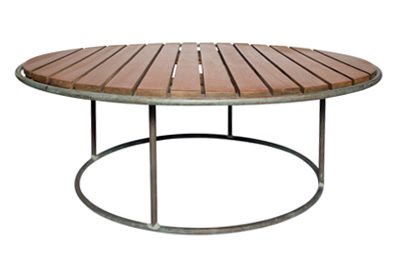
Lamb’s outdoor coffee table has a bronze tubular frame and is finished off with a redwood top. The result is a gorgeous contrast between the industrial-metal frame and the natural wood top.