Evelyn and Jerome Ackerman were influential Los Angeles-based mid-century modern designers whose work helped define the handcrafted warmth of California modernism. Working across ceramics, mosaics, tapestries, wood carvings, architectural hardware, metalwork and enamel, the husband-and-wife design duo created artful objects for the modern home through Jenev Design Studio and later ERA Industries. Their designs brought color, texture, folk-art references, geometric pattern and artisan craftsmanship into the clean-lined interiors of postwar Southern California. Today, Evelyn and Jerome Ackerman are recognized among the most important figures in California mid-century modern design, with work held in major museum collections and admired by collectors, architects, interior designers, and homeowners who see the mid-century home not just as architecture, but as a completely designed environment.
In This Article
- Evelyn and Jerome Ackerman: The Design Duo Who Defined California Mid-Century Modern Style
- From Detroit to Los Angeles: The Beginning of a Creative Journey
- Building a Career in Los Angeles: Jenev Design Studio and ERA Industries
- Ceramics: Where It All Began
- Mosaics: A Handcrafted California Vision
- Tapestries and Weavings: A Partnership Across Borders
- Wood Carvings and Architectural Panels: Bringing Art to Interiors
- Hardware: Drawer Pulls, Knobs and Door Hardware
- The Architects and Designers The Ackermans Worked With
- Material Curiosity by Design: The Craft Contemporary Exhibition and Palm Springs Modernism Week
- Find the Perfect Mid-Century Modern Home for Your Ackerman Collection
Evelyn and Jerome Ackerman: The Design Duo Who Defined California Mid-Century Modern Style
Evelyn and Jerome Ackerman played a pivotal role in defining California mid-century modernism. For anyone drawn to mid-century modern homes and the art that brings them to life, few stories are as rich or as inspiring as that of the Ackerman’s. For more than 50 years, this Los Angeles-based husband-and-wife team helped shape the distinctive visual language of California mid-century modernism, producing an extraordinary range of ceramics, mosaics, tapestries, wood carvings, hardware, and metalwork that continues to influence collectors, designers and mid-century homeowners.
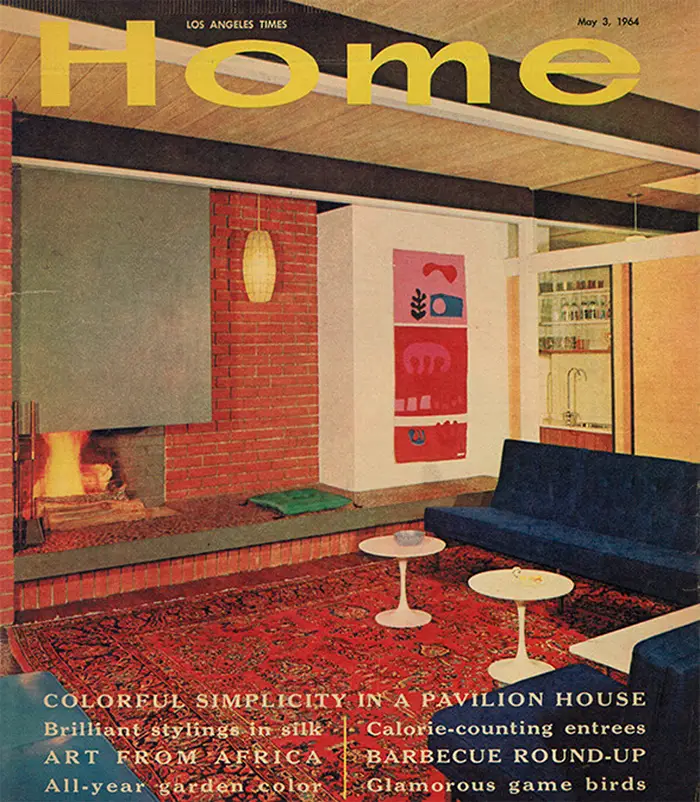
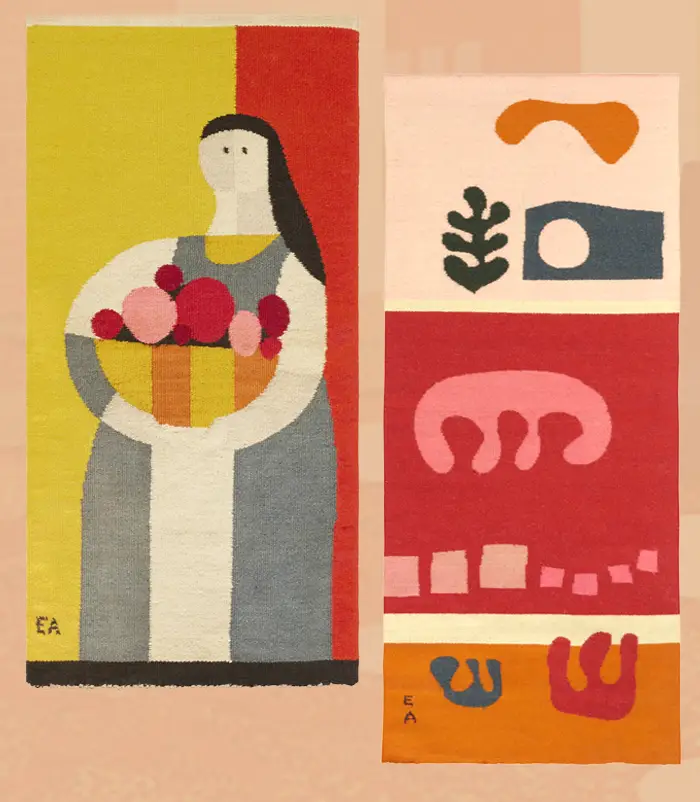
Evelyn Ackerman’s work was featured on the cover of the Home magazine in the LA Times in May 1964. Her tapestries reveal the emotional warmth of mid-century modern textile design. Their hand-woven surfaces added depth to rooms defined by glass, wood, stone and clean architectural lines. These works remain a beautiful reminder that California modernism was never only about structure, but also about texture, pattern and the human hand.
From Detroit to Los Angeles: The Beginning of a Creative Journey
Jerome (“Jerry”) Ackerman was born on January 29, 1920, in Detroit, Michigan. He graduated from Detroit’s Central High School and enrolled at Wayne University (now Wayne State University) as an art major. When the United States entered World War II in 1941, he left school to work in a naval ordnance plant and then joined the Air Force, serving as a control tower operator in Germany.
Evelyn Lipton was born on January 12, 1924, also in Detroit. She began her studies at the University of Michigan as an art major, then transferred to Wayne University as a fine arts and art history major after family circumstances brought her home. There, she was introduced to the German Expressionists, Rembrandt, Cézanne, Klee and Matisse by her art history professor, Dr. Ernst Scheyer. She completed her BFA degree with distinction in 1945 and her MFA in fine arts in 1950.
Evelyn and Jerome met at her sister-in-law’s interior design studio. The couple married in 1948, and the following year they saw a transformative exhibit at the Detroit Institute of Arts, “For Modern Living,” by Alexander Girard, a trained architect. This pivotal show showcased the creative work of Ray and Charles Eames, George Nelson and others, fundamentally changing the Ackermans’ vision. Jerry commented, “It opened our eyes to an exciting new way of thinking and design expression. We thought, if the Eames can do it, why can’t we?”
Jerome’s ceramics talent had already caught the eye of Charles Harder, chairman of the prestigious graduate ceramics program at Alfred University in New York, who invited him to join the program after seeing his senior exhibition at Wayne. Jerome completed his MFA in ceramics at Alfred University in June 1952. That same year, the Ackermans moved to Los Angeles, renting a small studio at 2207 Federal Avenue in West Los Angeles, where they opened Jenev Design Studio, a name combining “Jerome” and “Evelyn.” They arrived with very little money, enormous talent and an unwavering belief in the transformative power of modern design.
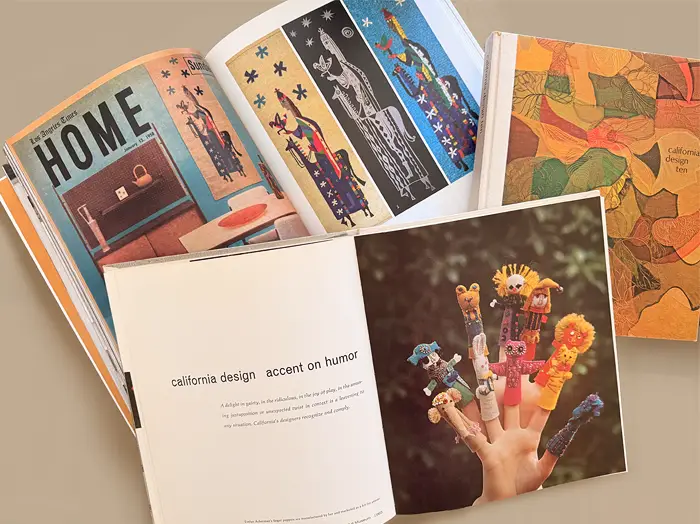
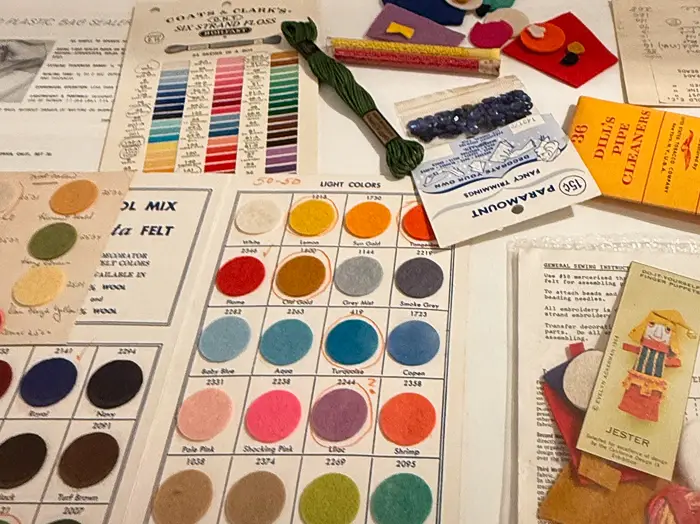
Evelyn Ackerman’s finger puppet kits reveal the playful, imaginative side of her California mid-century modern design practice. Created in 1964 after she learned hand-puppet making at a USC summer camp in Idyllwild, the embroidered felt characters were first developed as a fundraiser for her daughter Laura’s co-op nursery school before later being sold through ERA Industries. These charming do-it-yourself kits, featured in House and Garden and selected for California Design IX, show how Evelyn brought art, craft, storytelling and joyful modern design into everyday family life. Here is a collection of our favorite books, the California Design Series and the new book celebrating the Ackermans’ work.
Building a Career in Los Angeles: Jenev Design Studio and ERA Industries
The Ackermans moved to Los Angeles at exactly the right moment. The post-war population boom was transforming Southern California and a new generation of homeowners was furnishing their mid-century modern homes with clean-lined furniture and a fresh, optimistic aesthetic. The Ackermans would come to define what went on the walls, countertops, cabinet doors and floors of those stylish homes.
Jerry began creating his first group of slip-cast ceramics, spending nearly a year designing shapes, making molds and developing glazes. Their first clients included Carroll Sager Associates and Jules Seltzer, a prominent Los Angeles showroom for modernist furniture. The Jenev ceramics line was soon marketed nationally by independent sales representatives and was personally selected by influential furniture designer Paul McCobb for sale in his Directional Showroom. Their work began appearing in the “Home” section of the Los Angeles Times and in House and Garden, among other national publications. In those early lean years, Evelyn supplemented their income by answering fan mail for comedian Red Skelton.
In 1956, Jerry reconnected with a Detroit high school classmate, Sherrill Broudy, who shared his love of architecture and design. The two became business partners, and Jenev became ERA Industries, the name the business would carry for the rest of its run. After buying Broudy out, the Ackerman’s expanded their creative output dramatically, moving into textiles, woodcarvings, metalwork, mosaics, and architectural hardware. That same year, a design associate of architect A. Quincy Jones helped them complete a studio addition to their Los Angeles home, giving them the workspace their ambitions required.
The Ackerman’s held the rare distinction of being included in every exhibition of the prestigious California Design series from 1954 to 1976, held primarily at the Pasadena Art Museum. In 2013, the Los Angeles Conservancy Modern Committee presented them with its Modern Masters Award, recognizing a lifetime of achievement in modern architecture and design.
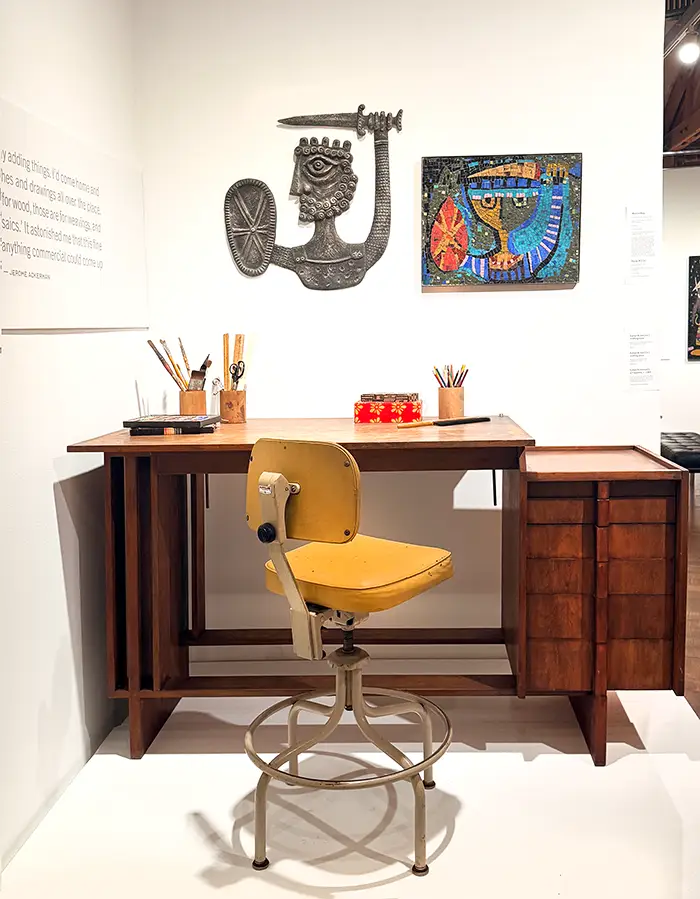
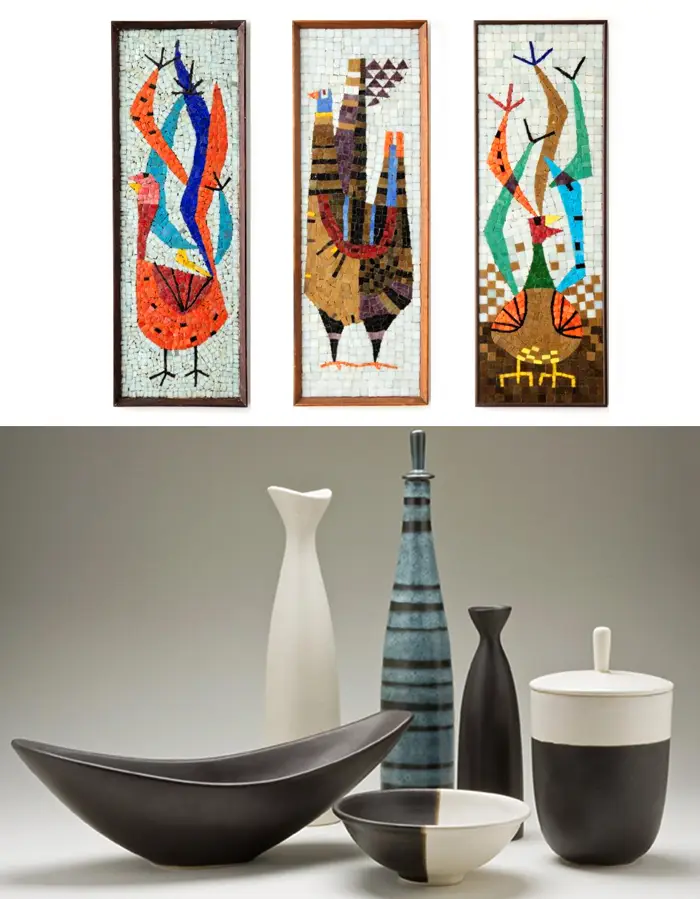
Such a moving tribute, Evelyn Ackerman’s drafting table by architect Eugene Alexander at the Craft Contemporary exhibition. Jerome Ackerman’s ceramics were the foundation of the Ackermans’ creative journey in Los Angeles. Trained as a ceramicist at Alfred University, Jerry created biomorphic vessels, bowls and vases that reflected both studio pottery traditions and mid-century modern form. Produced in small numbers through Jenev Design Studio, these ceramics remain among the most prized Ackerman works for collectors of California modern design.
Ceramics: Where It All Began
Jerome was a traditional studio potter at heart, influenced by Chinese Song Dynasty pottery. His training at Alfred University gave him a deep command of form and glaze and he channeled that into biomorphic shapes that reflected a mid-century modernist sensibility. Most Jenev ceramics were produced with a black-and-white matte finish, though Evelyn decorated some pieces. These vessels, bowls and vases were produced in small numbers, making them among the most prized for collectors. In 2017, Design Within Reach reissued a collection of six original Jenev ceramic designs, casting them from Jerry’s 1953 originals, a bold statement as to how well those early forms have aged. The Ackermans’ ceramics are now held in major collections, including the Smithsonian American Art Museum and the Los Angeles County Museum of Art.
Mosaics: A Handcrafted California Vision
While visiting a San Francisco exhibition in 1955, Evelyn viewed a mosaic that would inspire a new design direction. She quickly began creating mosaic wall panels and tabletops. These pieces became popular and in demand, it became clear she could not produce enough pieces on her own to meet the orders. To scale up production while maintaining quality, the Ackermans established a mosaic workshop in Mexico City, where artisans painstakingly hand-cut Venetian tesserae tiles to match Evelyn’s full-size templates and color-keyed cartoons. Between 1957 and 1965, more than 50 designs were produced in small batches in Mexico, each piece unique due to the nature of handcrafted work. ERA Industries, managed by Jerry, then distributed the mosaics to an American network of interior design firms, architects and retail establishments. Every carefully curated panel bore the subtle variations of the individual maker’s hand; no two were exactly alike.
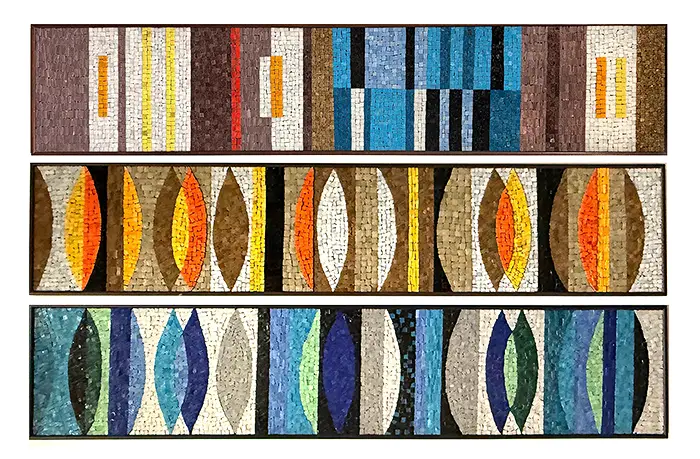
Evelyn Ackerman’s mosaics capture the soulful side of California modernism, where clean-lined architecture meets handcrafted artistry. Produced in small batches with hand-cut Venetian tesserae, each mosaic carried subtle variations that made every piece feel alive and deeply individual. For collectors and design lovers, Ackerman mosaics remain iconic examples of mid-century modern wall art with stylish decorative power.
Evelyn’s mosaic subjects drew from an eclectic range of sources: folk art from Central and South America, the Pacific Islands and ancient Mediterranean cultures. Birds, cats, horses, fish, zodiac figures and abstract botanical forms were among her most beloved motifs. The “Elipses” panel, co-designed by Jerry and Evelyn, became arguably their most iconic mosaic; an example is held in the permanent collection of the Los Angeles County Museum of Art. Evelyn also took on major architectural mosaic commissions. Her “Fantasy Landscape” mural, a 16’ x 32’ exterior mosaic created for an apartment building in West Los Angeles in 1956, was made in sections at the Jenev studio and is registered with the Los Angeles Mural Conservancy. A second mural, “Sea, Land and Sky,” was created in 1957 for a building in Santa Barbara and executed at ERA’s atelier in Mexico.
Tapestries and Weavings: A Partnership Across Borders
Evelyn had taken weaving in college and the Ackermans added woven tapestries to their ERA line as demand for wall art in mid-century modern homes continued to grow. Once again, when it became clear that Evelyn alone could not meet the demand for tapestries alone, they found a family of skilled weavers outside Mexico City, with whom they worked for more than 25 years. The tapestries were hand-woven in wool, with the largest works measuring 44″ x 70″, the maximum size the weavers’ looms could accommodate. The tapestries captured the same warm, folkloric sensibility as Evelyn’s mosaics, translated into the texture and depth of hand-woven wool. Designers regularly borrowed ERA tapestries for magazine photoshoots and the works appeared alongside the clean-lined furniture and open interiors that defined the era’s aesthetic ideal.
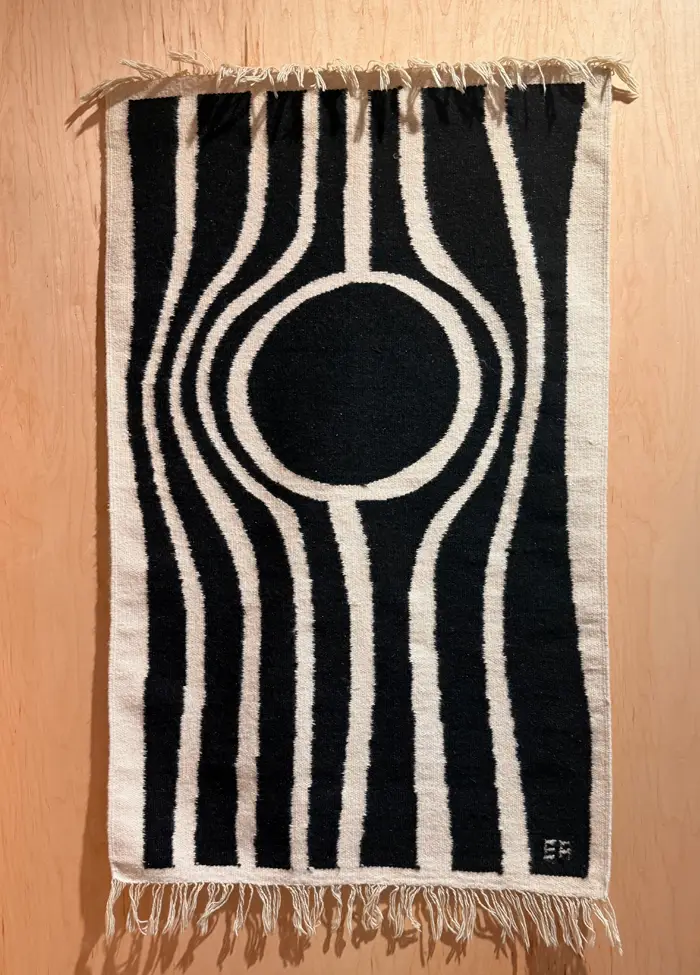
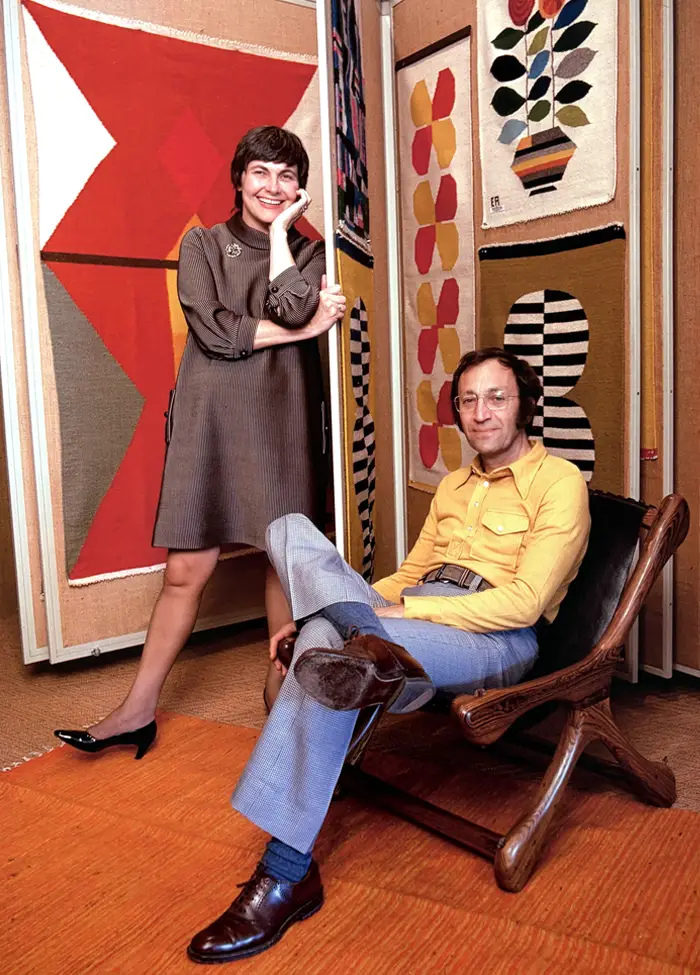
Evelyn Ackerman’s woven tapestries brought softness, color and global craft traditions into California mid-century modern homes. Hand-woven in wool by skilled artisans near Mexico City, the tapestries translated Evelyn’s folkloric patterns into richly textured wall art. Their scale, warmth and graphic strength made them natural companions to post-and-beam architecture, open-plan interiors and the expressive modern homes of Southern California. Evelyn and Jerome Ackerman at their ERA Industries showroom, Los Angeles, early 1970s. Photo: Bob Lopez
The Ackermans also worked with artisans in Japan, Greece, Kashmir and Italy for various textile and specialty commissions. One of the largest commission projects came in 1968, when Evelyn designed 12 custom 6’ x 8’ needlepoint tapestries for the new Litton Industries corporate office in Beverly Hills, executed by artisans in Greece from her full-size drawings. The project took a year and a half to complete.
Wood Carvings and Architectural Panels: Bringing Art to Interiors
Evelyn designed and Jerry produced their first group of carved wood bas-relief wall panels in 1959. Early designs included “St. George and the Dragon” and “Adam and Eve.” As demand grew, they brought in master woodcarver Maurey Spinak, whose workshop used multiple spindle-carving machines to rough out each piece before hand carvers finished them, a smart hybrid approach that preserved the handcrafted quality at greater volume. Evelyn’s modular carved wood panels with tongue-and-groove details served as the foundation for business partner Sherrill Broudy’s company, Panelcarve (later Forms+Surfaces), which was used extensively in hotels, restaurants, office buildings, schools and homes across the country. The Ucello series used on the doors and transom of the landmark Alan Ladd building in Palm Springs in 1971 became one of her most celebrated architectural designs.
In 1971, Evelyn designed a series of Animal Woodblocks carved from thick redwood, with 20 designs that could be used individually or in groups. These were included in the “California Design XI” exhibition and the accompanying book. The Ackermans also produced carved wood plaques for house numbers, carved gourmet accessories such as knife holders and spice racks and large-scale architectural door panels—a full ecosystem of designed objects for the modern California home.
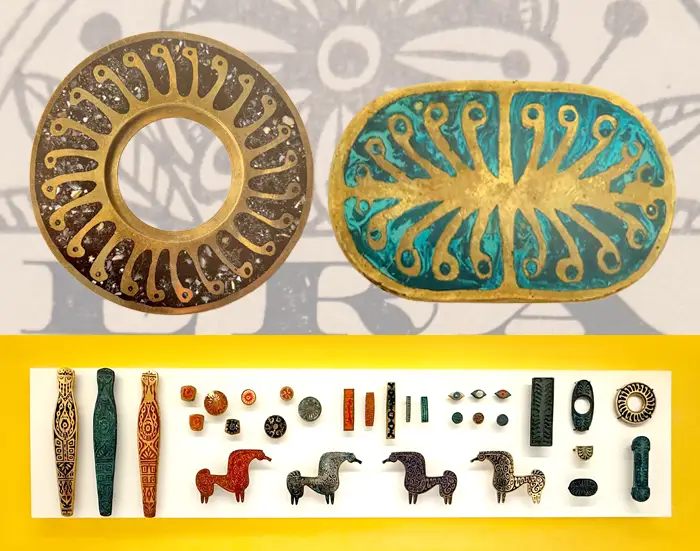
The Ackermans brought fine art into everyday function with metalwork and architectural hardware designed for modern homes. Their drawer pulls, knobs and door hardware combined solid brass, vivid inlays and precise craftsmanship, turning even the smallest design detail into a collectible object. In a mid-century modern interior, Ackerman hardware adds a layer of texture, color and authenticity that speaks to the era’s belief in total design. This collection of metalwork was on display at the Craft Contemporary exhibition in Los Angeles.
Hardware: Drawer Pulls, Knobs and Door Hardware
One of the most tactile and collectible dimensions of the Ackermans’ output was their hardware line, a category where fine art and everyday function met in miniature. Responding to what they saw as a void in well-designed contemporary hardware available to architects, designers and cabinetmakers, Jerry designed the “Antico” group of hand-cast solid brass knobs and pulls in verde and other finishes, produced in Italy with a variety of inlays. Large-scale inlaid brass door pulls, hand cast in limited production runs, were designed for architectural applications.
ERA also carried a line of recessed plastic pulls designed by Count Sigvard Bernadotte and produced in Denmark, which became a favorite of architects, designers and even boat manufacturers. Evelyn brought her mosaic sensibility directly to the hardware line, designing drawer pulls in solid brass with hand-set micro-mosaic tile inlays in vivid colorways, reds and oranges, yellows and whites, greens and blues, all produced in Italy and stamped with the ERA Industries mark. These pulls brought the same warmth and craftsmanship of the Ackermans’ wall art directly to the furniture and cabinetry of mid-century modern homes.
The Architects and Designers The Ackermans Worked With
The Ackermans’ reach extended across the full landscape of mid-century modern design. Their work was favored by leading architects and interior designers who recognized that ERA’s tapestries, mosaics, wood panels and hardware were the perfect complement to the clean-lined interiors of the era. Among the firms and designers they collaborated with were Victor Gruen, Skidmore Owings and Merrill, Paul McCobb, Steve Chase and Arthur Elrod, the Palm Springs-based interior designer whose own clients included Frank and Lucille Capra, Hoagy Carmichael and Claudette Colbert. A design associate of the iconic Los Angeles modernist architect A. Quincy Jones helped complete their own home studio.
Material Curiosity by Design: The Craft Contemporary Exhibition and Palm Springs Modernism Week
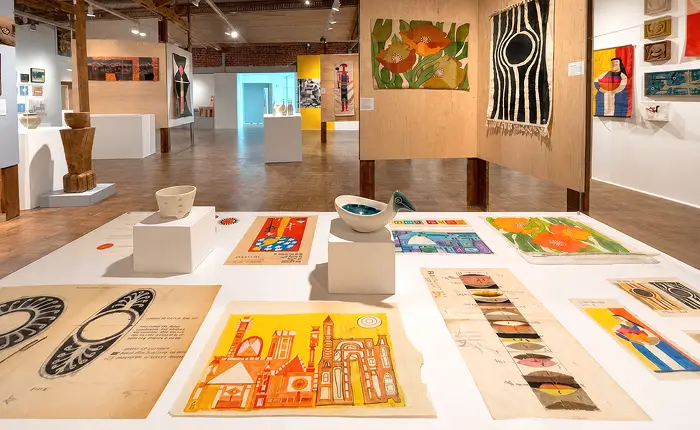
The Ackermans’ artistic relevance was on full display at the exhibition, “Material Curiosity by Design: Evelyn and Jerome Ackerman, Mid-Century to Today,” at the Craft Contemporary in Los Angeles. The exhibition explores their prolific careers and showcases some of their most well-known and collectible work.
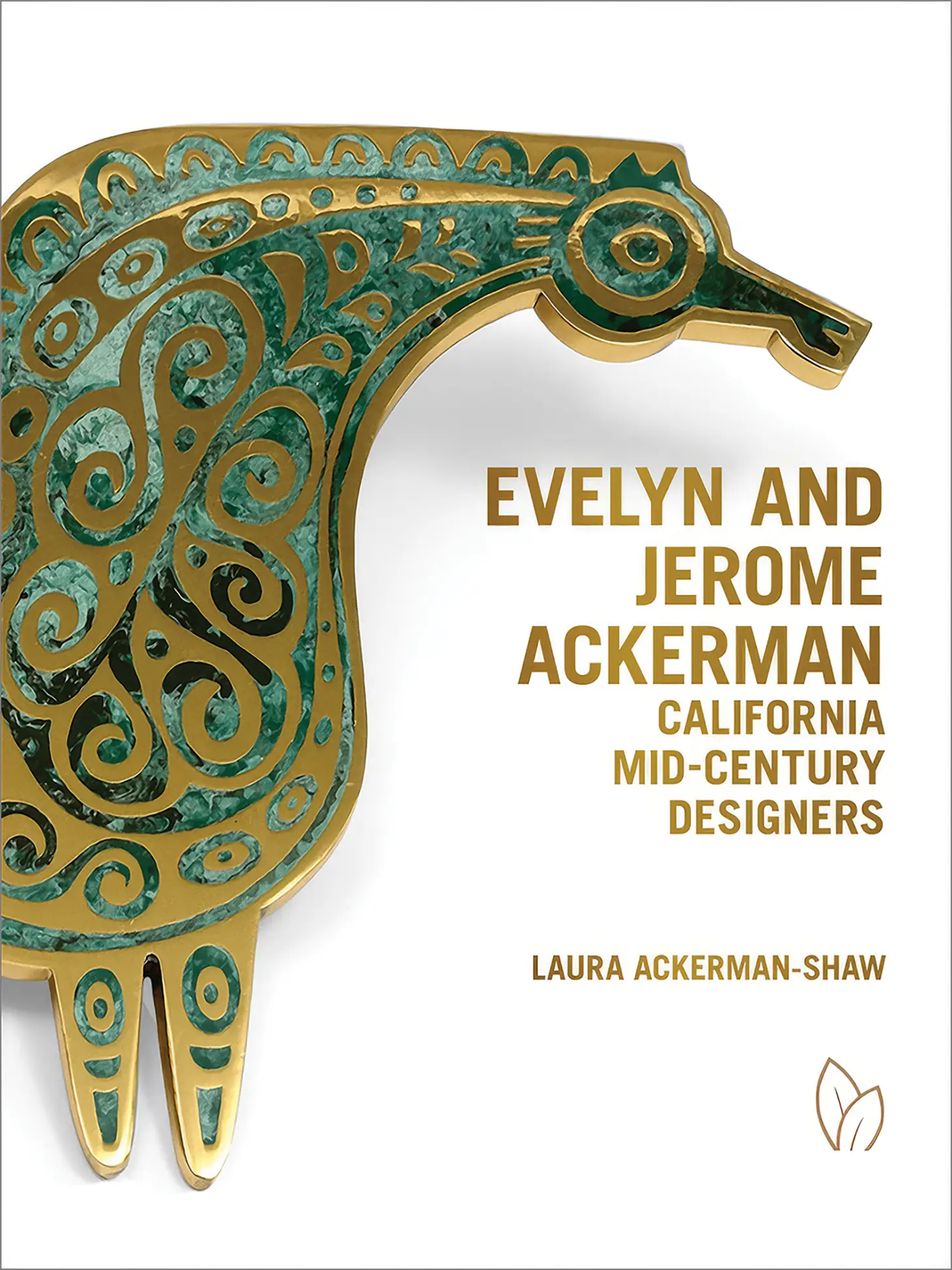
A beautiful new 256-page book, “Evelyn and Jerome Ackerman: California Mid-Century Designers,” celebrates the extraordinary creative legacy of this influential Los Angeles design duo. Written by their daughter, Laura Ackerman-Shaw, the book offers an intimate and richly visual look at the Ackermans’ ceramics, mosaics, tapestries, carved wood panels, metalwork, hardware and lasting contribution to California mid-century modern design. Through personal insight and archival depth, it reveals how Evelyn and Jerome Ackerman shaped a complete design world filled with color, craft, storytelling and modernist imagination. The book is a beautiful tribute to the artistry that continues to inspire contemporary interiors. Learn more through Ackerman Modern, where the Ackerman legacy continues to live.
The Ackermans’ story was brought vividly to life during the Palm Springs Modernism Week 2026. We were so inspired by the lecture presented by their daughter, Laura Ackerman-Shaw. Growing up, she recalled, her home was an eclectic mix of folk and tribal art alongside the work of Wegner, Eames, Nelson, Architectural Pottery and her parents’ own designs, a world Evelyn and Jerome created together. She shared personal insights about her parents, their design process, material exploration and their continuing impact on California design culture. Ms. Ackerman-Shaw has reintroduced Evelyn and Jerome’s work through Ackerman Modern. Select pieces are available at CB2 via their Design Legends series, where you will find rugs, dinnerware and decorative accessories celebrating the Ackerman’s work.
Find the Perfect Mid-Century Modern Home for Your Ackerman Collection
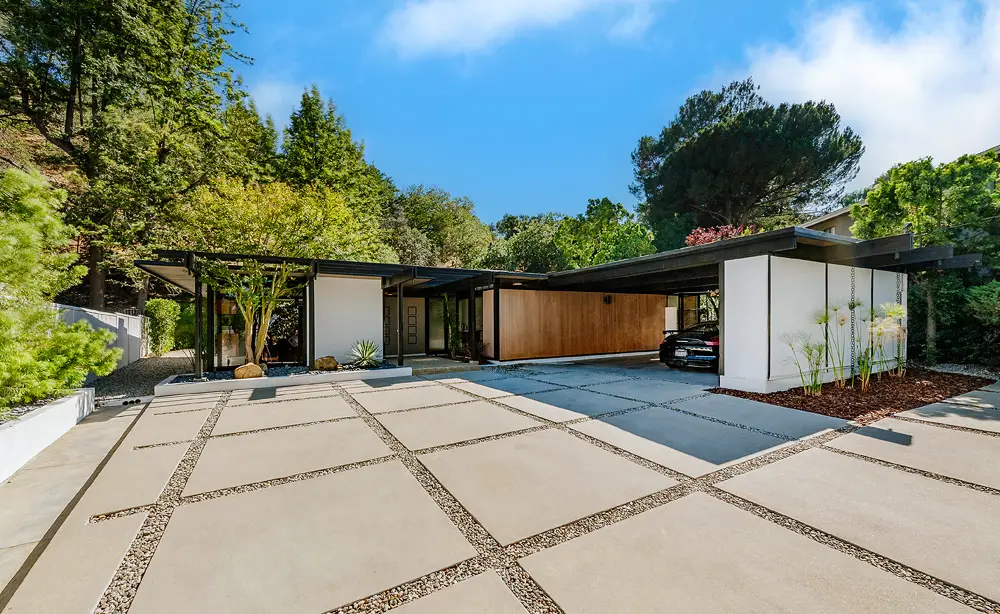
The Ackermans believed that beautiful design belongs in the homes of real people, not just in galleries. Their work was designed for young couples on a budget and for families who wanted their walls and surfaces to inspire. That philosophy feels more alive than ever as a new generation of collectors discovers their work and seeks out the homes built to hold it. If you are inspired by the Ackermans’ legacy and dream of living among the clean lines, warm materials and California light that defined mid-century modern design, Beyond Shelter Real Estate Group can help you find the perfect mid-century modern home to display your collection. Whether you are looking for a classic post-and-beam in the hills, an Eichler in the valley, a Palm Springs get away by a notable architect, or a restored California ranch with the soul of the era intact, Beyond Shelter’s team understands that a truly great mid-century modern home is more than just architecture; it is a way of living.Contact Beyond Shelter Real Estate Group and bring the Ackerman aesthetic home.