French designer Charles Dudouyt (1885-1946) is celebrated for his organic, beautifully crafted approach to furniture design. Working during the luxurious Art Deco and Modernist eras, Dudouyt created some incredible pieces from natural and organic materials. Wood was his material of choice, designing casepieces, tables and chairs from beech, oak and walnut. This master of organic simplicity had a bold vision for furniture design. Bulbous, geometric, yet functionally elegant, Dudouyt’s statement-making furniture pieces are the perfect fit for your Los Angeles historic home. These focal point furniture designs look particularly at home in one of Los Angeles’ period revival styles, English Tudor, French Normandy, or the rustic yet refined look of a classic Spanish Revival.
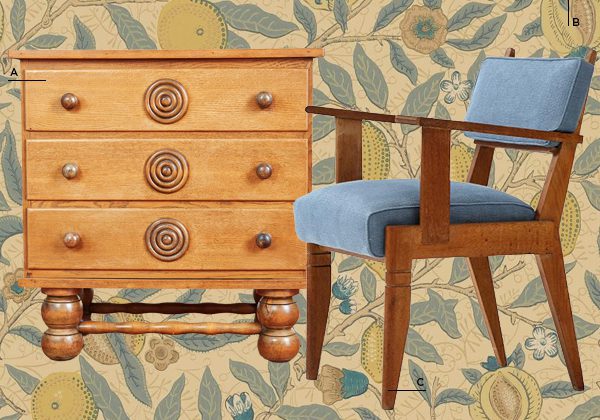
A | Dudouyt Oak Dresser c.1940s B | William Morris and Co Wallpaper-Fruit
C | Dudouyt Oak Armchair
Dudouyt was born in 1885; he studied at the Germain Pilon school, where he honed his drawing, painting and illustration skills. Upon completing his education, Dudouyt began creating illustrations for some of the most well-known French publications. After returning home from WWI in 1918, Dudouyt and his wife began designing decorative objects, eventually opening a furniture factory, L’Abeillée, in 1920. The designer moved to Paris in 1933, opening a workshop, The Gentilhommière. Dudouyt’s style shifted from the designs typical of the Art Deco era to more abstract geometric forms. The designer became heavily influenced by African, Tribal and Folk art and the geometric, abstract work of Picasso. As a contemporary of Alexandre Noll, Dudouyt was a key figure in reimagining France’s furniture and interior design movement towards a more Modernist sensibility, a movement he significantly influenced with his organic, beautifully crafted approach to furniture design.
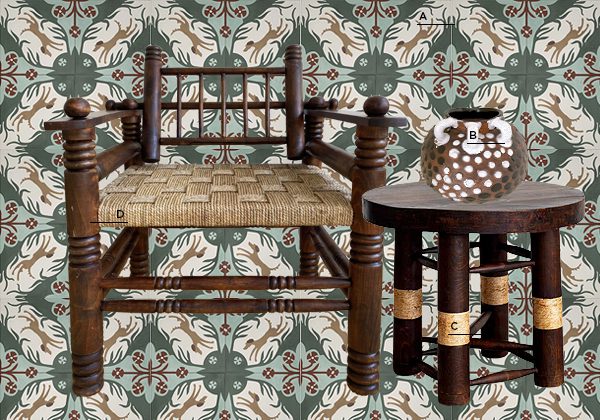
A | Hounds Cement Tile by Lili Tile B | French Ceramic Vase c.1920
C | Dudouyt Oak Side Table c.1940s D | Dudouyt Rush Seated Chair c.1950
Charles Dudouyt’s furniture pieces are warm, welcoming and authentic, making them a true showstopping addition to any room. The designer’s furniture echoes a sophisticated era of the past with bold bravado. His iconic designs continue to resonate with homeowners and collectors alike for their enduring beauty and detailed craftsmanship.
If you’re lucky enough to live in one of Los Angeles’ classic or historic houses or dream of living in one, there is no better addition to your interior space than a piece or two of Charles Dudouyt’s furniture. With organic, striking simplicity, his furniture designs bring something unexpected to an interior space. From buffets and sideboards to chairs, tables and lamps, his pieces tell a story we want to be part of.
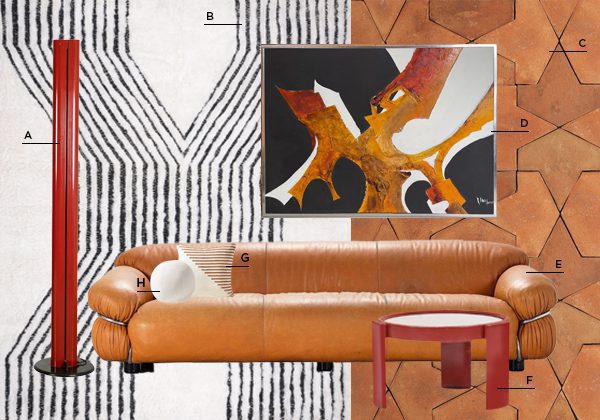
Architect-designer Gianfranco Frattini was born in 1926 in Padua, Italy. Frattini graduated from the Politecnico di Milano with a degree in architecture, studying under the iconic Gio Ponti. Although he began his career focusing on architecture, his interest soon shifted towards interior and furniture design. This move would make him one of the most influential Italian designers of the mid-20th century. Frattini became a member of the generation forging the Italian design identity post World War II, known for its dedication to craftsmanship, functionality, and beauty. Frattini’s design career soared in the 1950s, propelling him to the pinnacle of the design world. His collaborations with luminaries like Gio Ponti and Osvaldo Borsani defined an era and showcased his unique design philosophy. Frattini believed that ‘form follows function,’ a principle evident in his designs, which boast clean lines, practical utility, and a keen sense of proportion. Frattini states, “There is no decoration; the structure becomes the object.”

Frattini’s designs are marked by their subtlety, functionality and meticulous attention to detail. He had a particular affinity for working with wood, often experimenting with new techniques and forms to better express its natural beauty and warmth. Unlike many designers of his time, Frattini preferred soft, rounded forms, creating pieces that were visually appealing and incredibly comfortable. He didn’t believe in drawing attention to his works unnecessarily, preferring that his designs speak through their use and sculptural elegance.
American architect Cleo Baldon (1927-2014) was a pioneering figure in the worlds of furniture design, architecture, and landscape design. Baldon is recognized for bringing the concept of outdoor aspirational living to residences across Southern California. Her inspired furniture designs are at the top of collector’s lists, while her pool structures and outdoor living environments are still being admired today. Born in Leavenworth, Washington, Ms. Baldon came to Los Angeles to attend Woodbury University. She profoundly influenced California’s outdoor living and swimming pool culture and has been credited for famously introducing the lap pool concept to California back in 1970.
Cleo Baldon established the Venice-based landscape design firm Galper-Baldon Associates, a landscape architectural firm responsible for creating stunning outdoor environments across Los Angeles. She was passionate about transforming bland yards and backyards into lush, inviting spaces. Her partner, Sid Galper was the horticulturalist in the design practice. Baldon claimed she didn’t understand plants – that was strictly Sid’s territory. Throughout Southern California, Baldon created more than 3,000 swimming pools and was granted a design patent on the contour spa with seating designed to provide maximum comfort underwater.
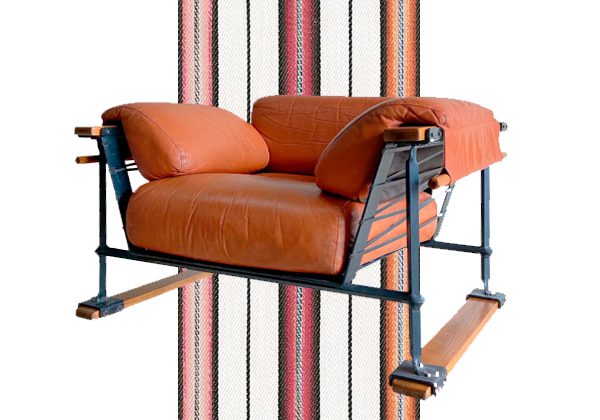
(Above) Extremely rare, iron and leather lounge chair, a hand-crafted studio piece from Baldon’s furniture company Terra, c.1960s. An excellent example of Baldon’s emphasis on quality construction hand-forged iron, leather and fir wood. Also known as the “saddle pack” chair with overstuffed armrests draping over the structural frame, referencing the designer’s inspiration from the American West. This design element is also seen in works by Sergio Rodrigues and Percival Lafer. Background fabric from Perennials – Far West collection in the Baja West pattern/Sol colorway.
Born into a wealthy family, French born designer Jean Royére (1902-1981), began his career as a banker in the import-export trade, leaving it behind in 1931 at the age of 29 to pursue his passion for design. Under an apprenticeship with Pierre Gouff, he learned cabinetmaking and meticulous craftsmanship. In 1934, Royére won a prestigious competition to design the restaurant of the luxurious Hotel Carlton on the Champs-Élysées finding immediate success.
In 1942 Jean Royére founded his own company and built an international career with global clientele including the Shah of Iran, King Farouk of Egypt and King Hussein of Jordan. He pioneered an original style combining bright colors, organic forms and precious materials with a vivid imagination. His international clientele was captivated by his elegant, yet playful style and his patrons entrusted him with the design and layout of their palaces. Royére continued to produce imaginative luxurious pieces until 1972. Since his pieces were made to order His pieces are highly coveted across the world today with furniture garnering six figures, $500,000 and up.
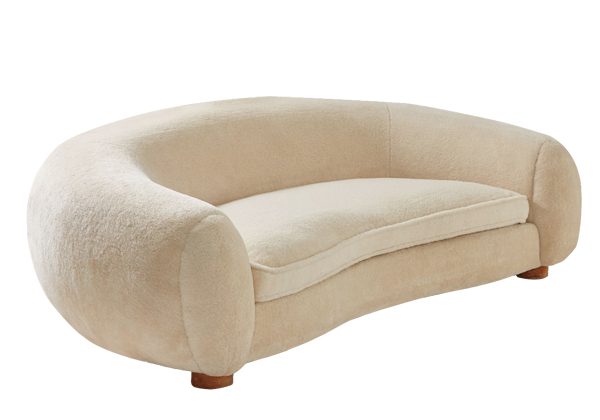
The “you’ll want to melt into” “Ours Polaire” sofa (French for polar bear) is one of the most coveted pieces ever designed by Royére. With its organic, rounded “come to me” frame, this piece has a cult following among the Hollywood elite including Jennifer Aniston and Kanye West. Upholstered in a soft woolen velvet reminiscent of a plush polar bear, nothing says “let’s stay in” better than this sculptural piece, c. the 1940s. Royére’s pieces work beautifully with work from another icon of French Modernism, Jacques Adnet.
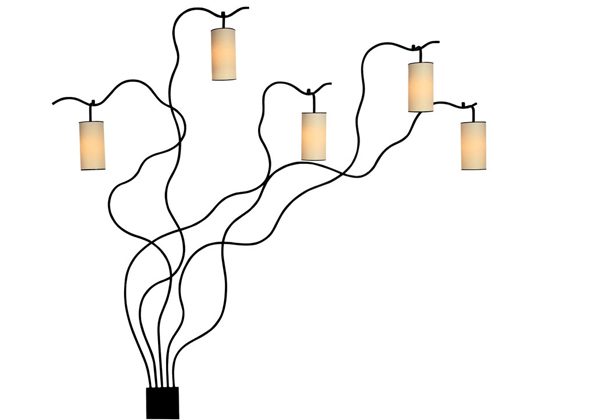
Royére’s “Liane” wall light, consists of organically shaped arms with five suspended parchment shades creating a spectacular focal point in any space. He offered these lamps in various configurations with varying numbers of lights, c. 1959.
Architect – designer Eileen Gray was born into an aristocratic family in Ireland in 1878. She studied at the prestigious Slade School of Fine Art in London before moving to Paris to study at the Académie Julian. Gray quickly assimilated into the city’s bohemian circles and was exposed to the progressive ideas that would define her work. Although she didn’t attend the influential Bauhaus school in Germany, she shared many of its philosophies and ideologies.
Although Gray began her career as a painter, she soon turned to design, creating both furniture and interiors. In Paris, Gray began working as an interior designer and soon established a reputation for her sophisticated and modern aesthetic. Gray originally focused on an Art Deco design aesthetic, creating stunning pieces utilizing high gloss lacquer. A technique she passionately studied under the Japanese master Seizo Sugawara.

After becoming interested in architecture in the 1920s, she quickly shifted towards modernism and what came to be known as the International-style. Gray began a relationship with the French-Romanian architect Jean Badovici. The pair would eventually design a house together in the south of France, villa E-1027 in Roquebrune-Cap-Martin on the Côte d’Azur. At this time she began experimenting with furniture design, creating iconic pieces like the “Bibendum” chair and the “Adjustable Table.” Many of her pieces combine a chromed steel frame with some type of upholstery, most notably leather. Her furniture was highly sought after by the wealthy elites of Parisian society. She soon became one of the most celebrated designers in the city. Patrons and collectors alike are drawn to Gray’s designs which are characterized by their simplicity, beauty and functionality from sleek side tables to rugs and elegantly upholstered chairs. Her furniture and objects are true works of art. Each piece is carefully designed and crafted to perfection. Throughout her career, Gray remained committed to innovation and creativity.
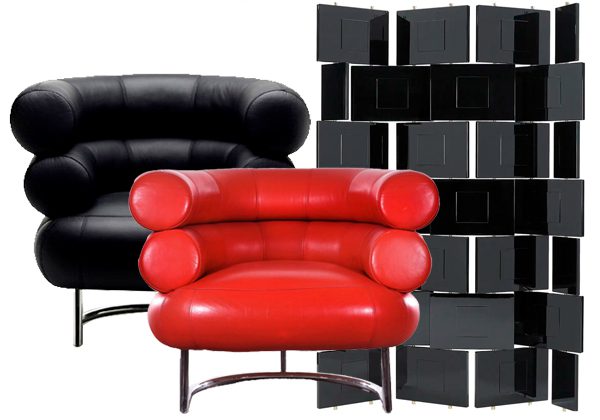
The Bibendum chair, designed in 1926 is a modern classic designed by Gray. The chair is made of curved tubular steel and leather and has a playful feminine character about it. It is curvaceous and comfortable with the shape reportedly influenced by the iconic overstuffed Michelin man character. The black-lacquered wood Block Screen, designed between 1922-1925 is a true work of art and showcases Gray’s ability to craft a modern piece influenced by Japanese decorative arts. Movable horizontal rows of panels are joined by steel rods creating a sculptural yet functional piece. The iconic screen is part of the Museum of Modern Art’s permanent collection and is available for purchase through ClassiCon.
Post-war designer Arne Norell, was born in Åsele, Sweden in 1917. In 1954, Norell opened a small furniture workshop in Stockholm and by 1958 he launched his eponymous manufacturing company, Møbel AB Arne Norell, still active today, with his work being carried on by his daughter and son-in-law. His company is set upon a two-acre farm in an idyllic countryside, which was the main source of inspiration for his work. Norell employed traditional materials, leather, turned and bentwood and metal in unexpected forms with a lyrical flair. His pieces are credited with an effortless casual character combined with all of the muted sophistication of Scandinavian modern design. Posthumously, in 1973, The British Furniture Manufacturers Association awarded Norell’s low-slung Ari Chair c.1966 – Showpiece of the Year.

Norell’s Inca 2-seat sofa chair is a masterpiece of construction. The solid beech wood frame is held together by strong leather supports without glue or screws c.1960s.

The Ari chair received the most recognition for Norell. In black buffalo leather and brushed flat steel frame, this chair expresses his wonderful curvilinear style, c.1960s, still being manufactured today.