Italian architect, designer and teacher Alberto Rosselli was born in Palermo in 1921. He was considered the “innovator” of architecture and one of the primary architects to emphasize the concept of industrial design as it relates to the structure as a whole. After graduating in 1947 from Milan Polytechnic University, Rosselli, he became the pioneer of Industrial Design and proposed new teaching techniques about the concept and process of “decision-making” in design. He decided to create furniture pieces that were modern, functional, simple and affordable.
In 1951, Rosselli designed the first kitchen for a two-person apartment encompassing the principles of functionality and adaptability, this informed his practice of design, concepts and ideas. Rosselli was inspired by the work of Gio Ponti, who became a role model and a figure he followed and studied in his formative years. In the 1950’s Rosselli began to work with Ponti, founding Ponti Fornaroli Rosselli / Studio PFR. During this time, he was involved in the planning of the Pirelli Tower, his first architectural commission. From the 1950’s to his death in the 1976 Rosselli created designs for everyday items – furniture pieces, clocks and electrical appliances, with the concepts of functionality and modularity as his guiding principles.
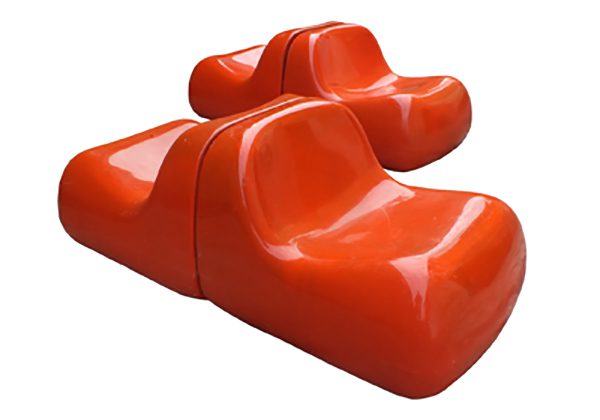 “Poltrone Jumbo” modular seating elements constructed of fiberglass, designed in 1968 for Italian furniture manufacturer Saporiti, available in red, black, blue and white.
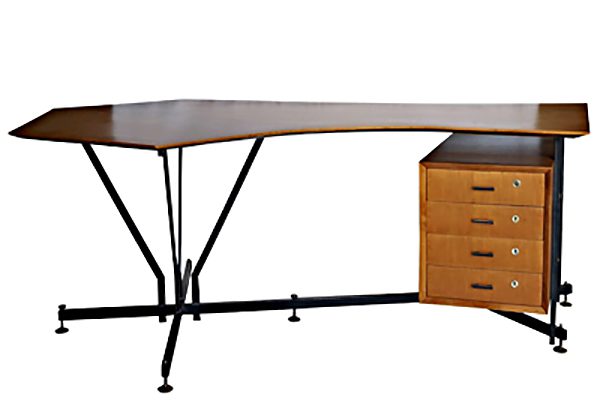 Mid-Century Modern Trapezoid Desk c.1955, composed of a long teak top with floating attached drawers on an iron frame. Designed by Studio PFR.
Mid century modern designer, Jacques Adnet was an icon of luxurious French Modernism. He attended École des Beaux-Arts in Paris and was inspired by pre-classical styles and his avant-garde take on traditional pieces. Adnet believed in the functional aspect of furniture combined with geometric simplicity above all else. His streamlined, mid century modernist designs emphasized luxurious materials – such as leather, chromed metals, mirror and precious woods. In 1950, Adnet formed a partnership with the French fashion house, Hermés, where he developed a collection of leather-covered furniture and interior accessories. His pieces look right at home in many styles of Los Angeles homes from classic mid century to historic Spanish, Tudor, Craftsman or Traditionals. One of his most iconic designs is the Adnet Mirror, a single circular pane hung from a leather strap. “What a lot of work to achieve simplicity,” he once said. During the 50s he received numerous commissions as the designer for private apartments of the President at the Elysée Palace and the meeting room of the UNESCO headquarters in Paris. Throughout his career, Jacques Adnet forged relationships with a team of noteworthy collaborators including Charlotte Perriand, George Jove, Alexandre Noll and Serge Mouille. Ultimately he is best known as a mid century designer who linked tradition and modernism with his inventive, elegant creations, defining himself as ‘innovative and classical, the champion of a tradition looking forwards.’
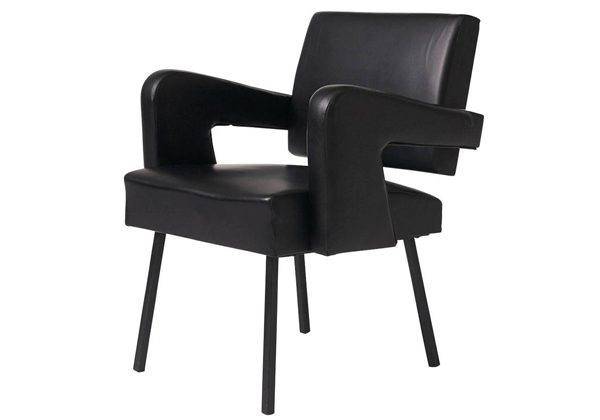
This Adnet armchair is constructed of black leather, with a cantilevered back perched on an enameled steel base, from the early 1950s.

Adnet’s black bamboo desk has a central drawer with a gilded brass ring under a panel suspended over two saw horse splayed legs, in brass, steel and leather. Adnet’s design from the 1950s still influences desks designed today.
Born in the Italian countryside of Brianza to a well-to-do bourgeois family, Franco Albini (1905-1977) was inspired by his fond memories of the landscape and the precise beauty of tradition. After attending architecture school in Milan, he served his apprenticeship with Milanese Architects Gio Ponti and Emilio Lancia where he had direct contact with artisan cabinet-makers and talented craftsmen. In 1930 he opened his own practice. Utilizing the knowledge he gained from working with talented craftsmen – he created his own unique aesthetic, elegant design merged with traditional Italian artisanship and the new conceptual movement of modernism. In 1928 Albini created the iconic Albini Desk, which combined steel, glass and wood in a minimalist combination of balanced proportions. He continued to design some of the most famous and fashionable furniture pieces for companies such as Cassina, Arflex, Arteluce and Poggi and in 1964 he created a television set for Brionvega. Albini also worked as an architect and interior designer on important buildings in Rome and subway stations in Milan.
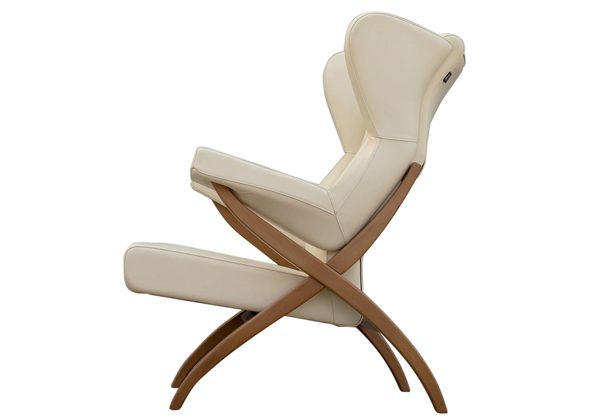
Albini’s Fiorenza Chair, c.1952 was designed for Arflex. This lounge chair in leather with a wood frame embodies his ability to combine traditional elegance with modernist minimalism and clarity of form.
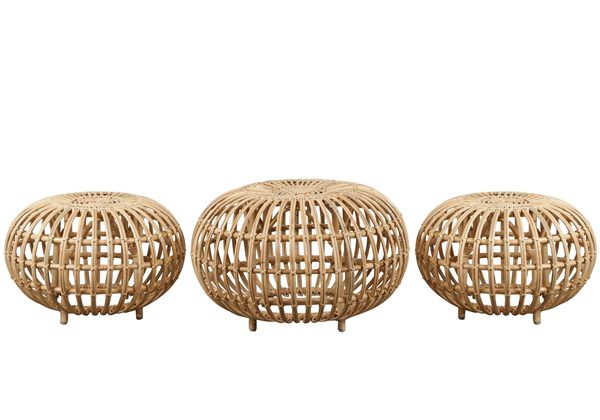
These rattan ottomans and poufs combine Albini’s rationality of form with the beauty of raw simple material c.1951.
Finnish designer Paavo Tynell (1890-1973) was a master of lighting and working with his favorite material, brass. Paavo Tynell began his studies as a tinsmith and continued his education at the school now known as Aalto University School of Arts, Design and Architecture. It was while working as a designer at Taidetakomo Koru, Tynell made his first brass lamp and he was immediately drawn to the material. He developed an easily recognizable style by combining a few simple principals – perforated brass metal, an ornamented yet sleek design, a unique lift mechanism and nature as inspiration. Tynell is most well known for his design Lumihiutale (Snowflake), shown below. He also produced pieces for two American companies Lightolier and Litecraft. In addition to his mass produced lighting designs, Tynell created custom pieces for many public spaces, including hotels, train stations and restaurants. Several contemporary Scaninavian modern lighting pieces are inspired by Tynell’s ahead of the curve designs, while his original pieces are highly collectible on today’s auction circuit.

This stunning Tynell rectangular flush mount ceiling light is made of black lacquered brass with pinhole perforations. Part of his Starry Sky series, the brass grid underneath supports a frosted glass diffuser which provides for beautiful light distribution, c. 1950’s.

One of Tynell’s signature designs, the Snowflake chandelier is from his Fantasia series. This model 9065 is from the early 1950’s and is constructed of perforated and enameled brass and metal mesh.
Ico Parisi (1916-1996), a Sicilian born architect, was one of the most influential designers and visionaries to shape the look of the 1950s. Parisi had a fertile imagination and was considered somewhat of a Renaissance man, he was active in the areas of filmmaking, furniture, glass and jewelry design – as well as an artist and architect. He collaborated with his wife Luisa, who was a student of renowned architect and designer Gio Ponti throughout much of his career. The Parisi’s work contains no ornamentation but it is fluid and in constant motion, the sofa’s look as if they could walk out of the room. The curvilinear styling of their upholstered sofa’s and chairs appears fabulously sexy and unique. Parisi’s work epitomizes the modernist style of the early atomic age and has become highly collectible.

One of Ico and Luisa’s classic pieces, this lounge chair, model 865, c.1954 is constructed of upholstery, steel and brass. A similar model was included in the tenth Triennial in Milan in 1954.
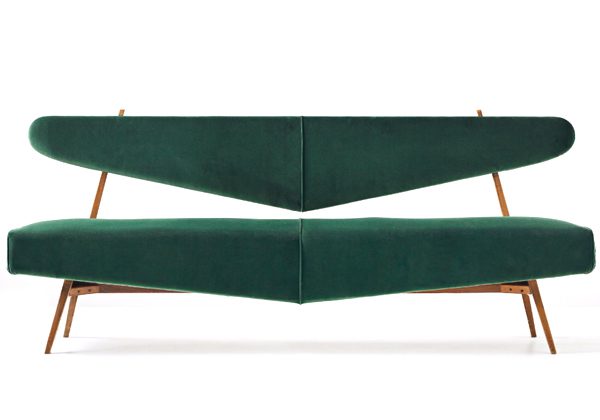
Created as a important private commission, this walnut and fabric sofa was executed by Spartaco Brugnoli, Italy in the early 1950’s.
Polish born Jorge Zalszupin, b.1922 moved to Brazil after World War II. It was an extremely creative time to rebuild a post-war world and the atmosphere in Brazil allowed his sensual, modern approach to design and architecture to flourish. In 1959, Zalszupin started the furniture design firm L’Atelier, which saw immediate success. He became part of a select team of talented furniture designers who worked closely with Oscar Niemeyer on developing furniture pieces for the new federal capital. His work is characterized by both geometric lines and organic forms combined with impeccable woodworking and classical detailing. Jorge Zalszupin is known for his refined work in jacaranda and other Brazilian specialty woods such as rosewood and ironwood. L’Atelier’s designs stand as benchmarks of modernism today and Zalszupin is considered one of Brazil’s most important designers of the twentieth century.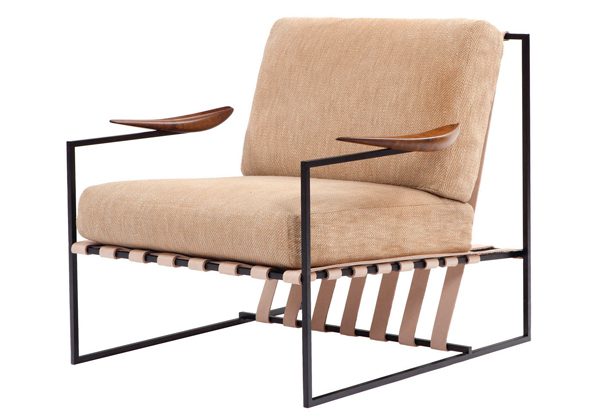
The Annette armchair is named after Zalszupin’s wife. This chair is comprised of a metal frame structure, a leather strap base and solid Imbuia wood carved arms. Originally designed in the 60s, there is now a re-edition of this stunning piece available.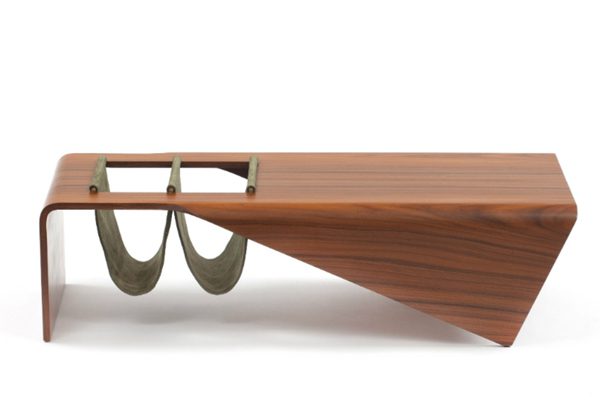
Named after the Swallow bird, the Andorinha coffee table is inspired by origami paper folding art and contains an integrated magazine holder.