Architect Frank Gehry is known to the world for buildings that seem to move: the rippling titanium of the Guggenheim Museum Bilbao, the billowing stainless steel of the Walt Disney Concert Hall here in Los Angeles. But for collectors of design and lovers of the architectural home, the real revelation is smaller and closer at hand. Throughout his career, Gehry was also a prolific maker of objects: furniture, lighting, sculpture, handbags, watches, a perfume bottle, a cognac decanter and an iconic tea kettle. The same ideas that animate a Gehry building first took shape in a chair you could sit in or a lamp you could switch on. This Designed Living: Distinctive Designers Feature examines Frank Gehry’s objects, from cardboard chairs to a fish-shaped tea kettle, that reveal the iconic architect’s curiosity and design philosophy.
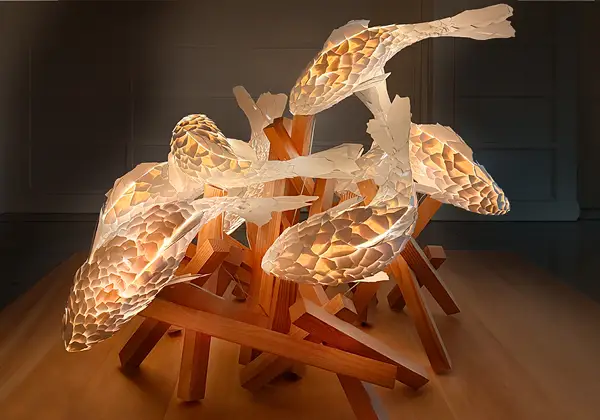
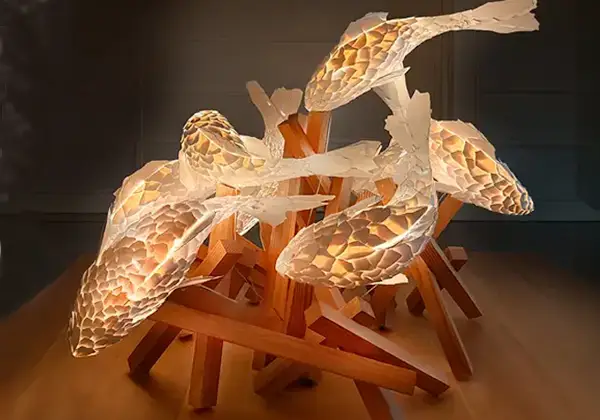
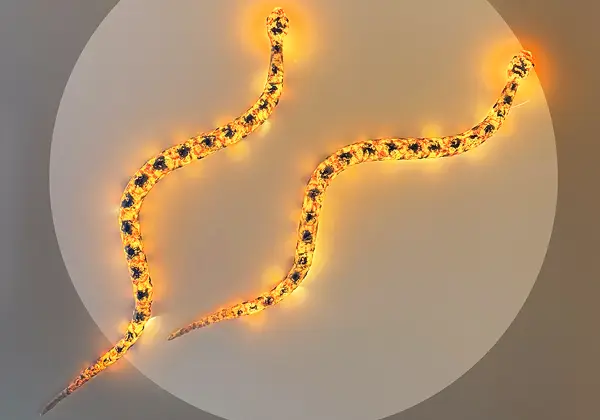
Frank Gehry’s ColorCore Fish Lamps extend his fascination with fluid form, light and movement beyond architecture and into the intimate world of interiors. Created with glowing, scale-like surfaces, the Frank Gehry Fish Lamps bring a luminous sense of motion to the room, as if sculpture and creature have become one. These works reflect Gehry’s lifelong interest in fish as a source of form, energy and expressive freedom.
Gehry's Iconic Furniture Pieces
A great entry point for examining how Frank Gehry thinks is through his furniture design. His chairs were never afterthoughts to the buildings. They were the laboratory where he tested his lifelong obsession: turning cheap, overlooked, supposedly flimsy materials into something structurally sound and unexpectedly beautiful.
Easy Edges (1969-1973): The Cardboard Chairs That Made GEHRY Famous
In the late 1960s, Gehry was an emerging Los Angeles architect surrounded by the corrugated cardboard he used for building models. Experimenting with the scraps, he discovered that laminating cardboard in layers with the corrugation running in alternating directions made the finished block incredibly strong. This material could support the weight of a small car and when layered, it developed a soft, suede-like surface on all sides. He called the engineered material “Edge Board,” and from it came Easy Edges, a collection of seventeen pieces produced between 1969 and 1973.
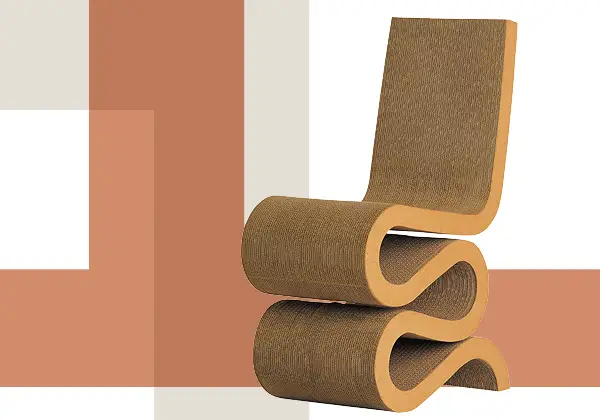
The much-loved Frank Gehry Wiggle Chair from the Easy Edges series stands as one of the great objects of 20th-century design, bridging architecture, furniture and sculpture with remarkable clarity. Its sinuous cardboard form captures Gehry’s distinctive design style, in which movement, material honesty and unexpected construction become part of the experience. More than a chair, it is a compact architectural statement that shows how radical beauty can emerge from humble materials.
In the late 1960s, Gehry was an emerging Los Angeles architect surrounded by the corrugated cardboard he used for building models. Experimenting with the scraps, he discovered that laminating cardboard in layers with the corrugation running in alternating directions made the finished block incredibly strong. This material could support the weight of a small car and when layered, it developed a soft, suede-like surface on all sides. He called the engineered material “Edge Board,” and from it came Easy Edges, a collection of seventeen pieces produced between 1969 and 1973.
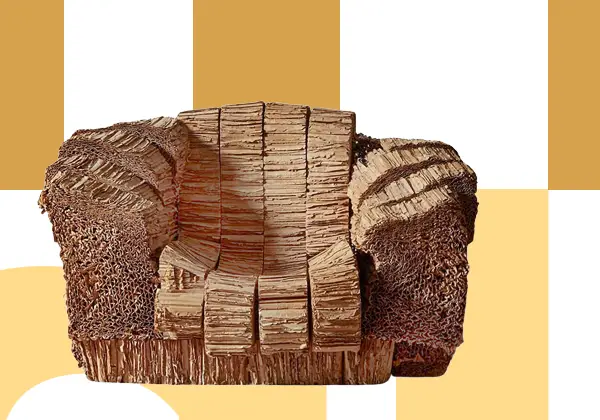
Frank Gehry’s Experimental Edges furniture reveals the same inventive spirit that made him one of the most influential architects of our time. Designed from layered corrugated cardboard, the furniture pieces transformed an everyday industrial material into an icon of sculptural modern design. Long before his most famous buildings reshaped city skylines, Gehry was already challenging convention through furniture that felt architectural, experimental and alive. Shown here the “Grandpa Beaver” chair.
Easy Edges was an immediate hit and he pulled it from production after roughly three months, fearing that fame as a furniture designer would pull him away from architecture. Today, original pieces are held in the permanent collections of the Museum of Modern Art and the Vitra Design Museum and the Wiggle Side Chair has been reissued by Vitra since 1992 and it remains one of the most recognizable furniture designs of the twentieth century.
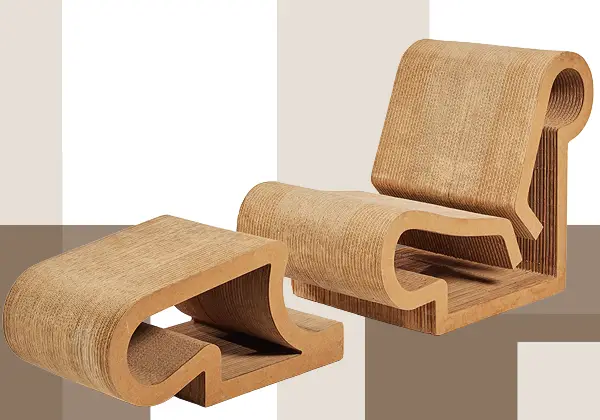
Another of Gehry’s Easy Edges designs, this chair and ottoman were created in 1972. He found that corrugated cardboard was incredibly strong when layered in opposite directions. When Gehry’s furniture designs became popular, he feared their popularity would overshadow his architecture and paused production.
Experimental Edges (1979 to 1982): Cardboard Gets a Makeover
When Frank Gehry returned to working with corrugated cardboard a decade later, it was with a different attitude. Where Easy Edges was refined and retail-ready, the Experimental Edges series treated the material as raw sculpture. This time the cardboard was thicker, rougher and more massive, with shaggy, exposed edges that flaunted the layered construction rather than hiding it. For Gehry, the line between furniture and sculpture was closely connected. The point was no longer affordable mass production; it was art you could sit on.
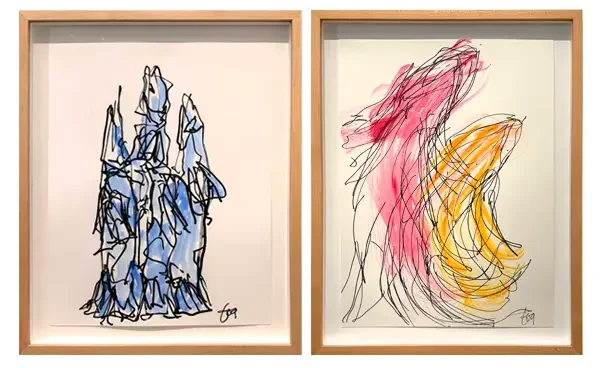
Frank Gehry’s fascination with the fish form began with a childhood memory that stayed with him for life: his grandmother keeping a live carp in the bathtub before preparing gefilte fish. That image of a moving body, turning and twisting in water, became imprinted in Gehry’s imagination and later surfaced in his Fish Lamps, fish sculptures and architectural design language. It became a way to think about movement, surface and structure. From shimmering fish scales to fluid, curving forms, Frank Gehry transformed a private memory into one of the most recognizable motifs in contemporary architecture. Buildings such as the Guggenheim Bilbao and Walt Disney Concert Hall suggest a similar sense of rippling energy. In Gehry’s hands, the fish shape offered a living alternative to static geometry, inspiring an architecture that bends, glimmers and appears to swim through space.
Knoll Bentwood (1989 to 1992): Weaving Wood Like a Basket
In 1989, Gehry approached the storied furniture maker Knoll with an idea inspired by something quite ordinary: the humble wooden bushel basket and the apple crates he had played on as a child. He had noticed that thin, woven wood strips could be flimsy on their own yet remarkably strong once interlaced. The result, released in 1992, was a line of bentwood furniture made from ribbon-like strips of hard white maple veneer, laminated six to nine plies thick and woven into open, basket-like forms.
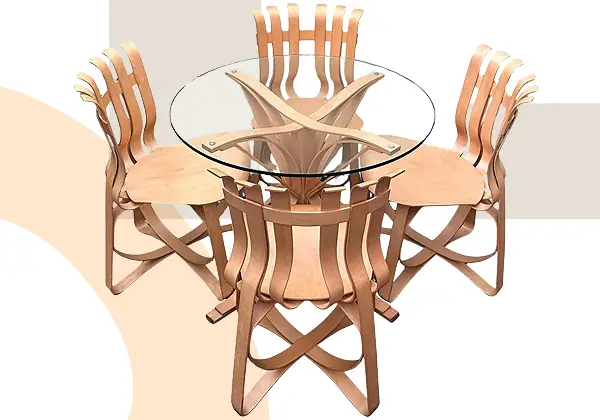
Frank Gehry’s Hat Trick Table and Chairs reveal a softer, more fluid chapter in his furniture design, moving from the corrugated cardboard of Easy Edges into sculptural bentwood forms for Knoll. Inspired in part by the humble structure of apple boxes, the Frank Gehry Hat Trick Chair transforms utilitarian logic into graceful movement, with thin maple strips woven into a surprisingly strong and expressive seat. Like his architecture, the design feels animated from every angle, turning everyday construction into something elegant, inventive and unmistakably Gehry.
Earlier bentwood furniture relied on a heavy main frame with a separate seating structure layered on top; in Gehry’s pieces, the same lightweight wooden strips form both the structure and the seat at once, a single continuous idea that springs and flexes for comfort without any metal connectors. He gave the pieces playful names borrowed from his beloved sport, ice hockey: Cross Check, Power Play, Hat Trick, High Sticking and Face Off. The Cross Check armchair, with its woven maple seat that subtly flexes as you lean, remains a design landmark and a favorite of architectural interiors.
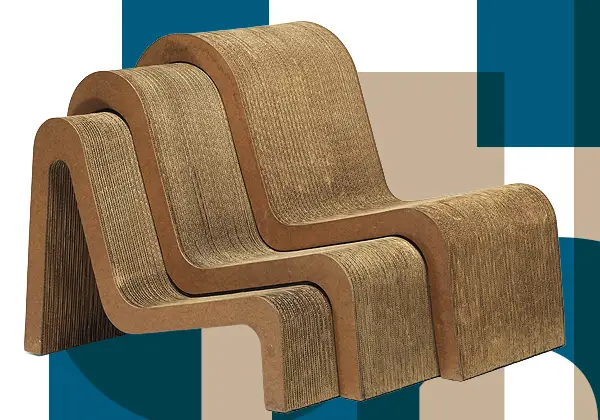
Frank Gehry’s Easy Edges stackable nesting chairs capture the radical spirit of 1970s experimental furniture design and show the architect’s gift for making innovation feel effortless, tactile and beautifully practical. Formed from layered corrugated cardboard, these Frank Gehry chairs turn a modest industrial material into sculptural furniture with rhythm, strength and architectural clarity. Their nesting design adds another layer of intelligence, allowing each chair to become part of a larger composition when stacked together.
Lighting and the Fish: The Motif That Defined a Career
If one image runs through all of Gehry’s object work, it is the fish. The motif traces back to a childhood memory: his grandmother kept a live carp swimming in the bathtub before preparing gefilte fish for the Sabbath meal. That shimmering, twisting creature lodged permanently in his imagination and resurfaced throughout his life in his furniture, sculpture, product design and the curving silhouettes of his buildings, a private symbol of vitality, movement and flexibility.
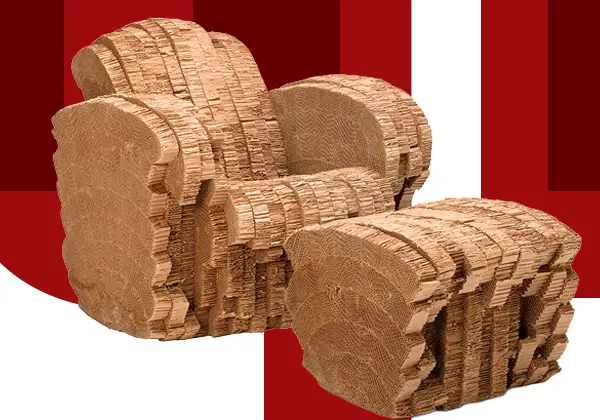
The Frank Gehry “Little Beaver Chair and Ottoman” captures the radical intelligence of the Experimental Edges series, where cardboard is treated not as disposable packaging but as a structural, raw, and sensual material. Layer by layer, the corrugated surface moves with remarkable fluidity, giving the chair and ottoman a tactile grain that reads almost like wood, topography or flowing fabric. In this compact design, Gehry proved that strength and softness could coexist, creating modern furniture that is playful, durable and unmistakably architectural.
The fish first became a body of work in the early 1980s, when the Formica Corporation invited Gehry to experiment with ColorCore, a colorful plastic laminate. As he told it, he shattered a piece in his workshop and in the shards suddenly saw fish scales. Gluing the fragments over wire armatures, he created glowing ColorCore fish lamps (1983 to 1986) that turned an industrial product sample into a radiant, living sculpture. He never let the form go; the fish lamps returned as centerpieces, time and again glowing with soft amber light and appearing to wriggle and curl across walls, floors and ceilings.
From Sculpture Garden to 3 World Trade Center
Alongside the lamps, Gehry built a freestanding sculpture at an architectural scale. His Standing Glass Fish of 1986 swims through the Minneapolis Sculpture Garden and a monumental fish form anchors the Vila Olimpica in Barcelona. He kept exhibiting whimsical new sculptures into his nineties, increasingly in New York. In 2024, Gagosian’s Madison Avenue gallery showed Ruminations, drawing on the aquatic forms that had occupied him since the Formica commission and his twenty-by-seven-foot Untitled (Fish on Fire, Greenwich Street) was unveiled in the lobby of 3 World Trade Center, the culmination of a lifetime chasing the same elusive creature from Los Angeles to Lower Manhattan.
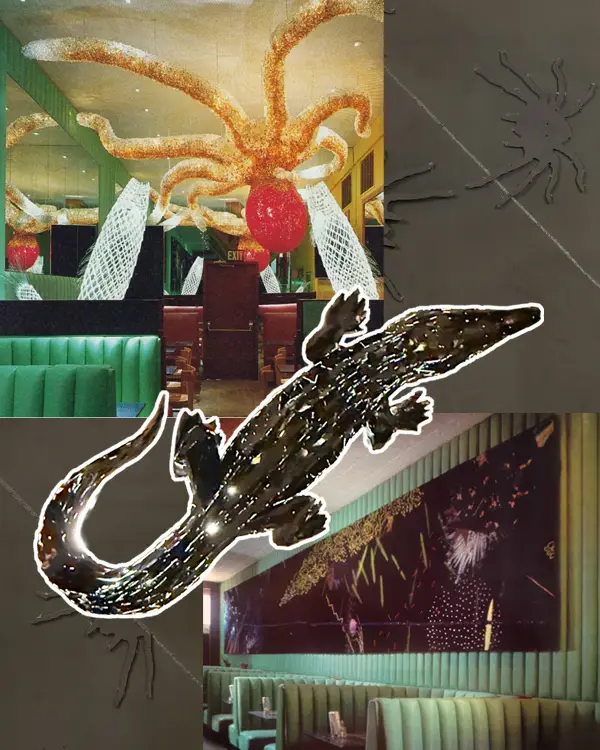
At Rebecca’s Restaurant in Venice, California, Frank Gehry transformed a dining room into a kinetic world of art, light and Los Angeles attitude. The Gehry crocodile lights and crystal octopus chandelier gave the interior a mythic, underwater charge, echoing the architect’s lifelong fascination with fish forms, movement and organic geometry. Paired with artwork by friends Ed Moses and Peter Alexander, the space revealed Gehry’s ability to turn a restaurant into a cultural landmark of California design.
Rebecca's Restaurant: The Venice Room Where It All Converged
Many of these threads first came together in one unforgettable room in Los Angeles. In 1983, restaurateurs Bruce and Rebecca Marder commissioned Gehry to design the interior of Rebecca’s, a high-end Mexican seafood restaurant in Venice. He filled it with light fixtures shaped like sea creatures: two pendant crocodiles of painted metal and glass, a fish and a massive chandelier in the form of a red crystal octopus and he installed work by artist friends, including Ed Moses and Peter Alexander.
Rebecca’s instantly became the favored haunt of Brat Packers and other 1980s Hollywood figures, who drank tequila beneath its glowing menagerie. Remember that scene in Less Than Zero? When the restaurant closed, the fixtures were auctioned off and the crocodile sculptures resurfaced at Bonhams in 2022. The restaurant was the laboratory where Gehry’s sculptural lighting, his sea-creature vocabulary and his collaborations with the Los Angeles art world converged in a single, immersive, experiential interior. This was an early demonstration of his belief that a designed environment could be as expressive as a painting.
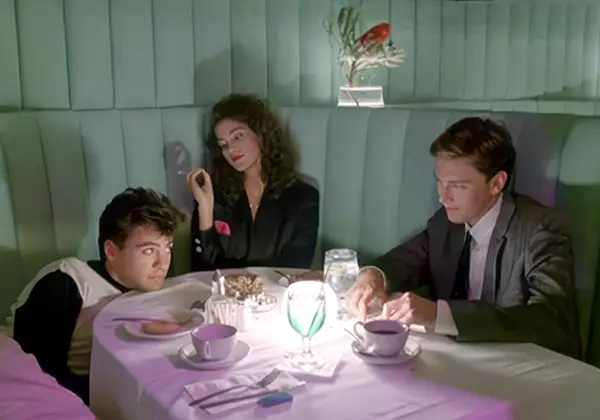
The Frank Gehry-designed Rebecca’s Restaurant in Venice, California, gave the film Less Than Zero one of its most stylish and emotionally charged backdrops. In this restaurant scene, Robert Downey Jr., Andrew McCarthy and Jami Gertz sit within an interior that reflects Gehry’s playful architectural language, where color, light and sculptural detail turn dining into atmosphere. Directed by Marek Kanievska, the film preserved a rare glimpse of Rebecca’s, a now-legendary restaurant where Gehry’s experimental design met the glamour and unease of 1980s Los Angeles.
The Los Angeles Art Scene That Shaped Gehry
Gehry’s vision was shaped less by other architects than by the painters and sculptors of the Los Angeles art scene. In the 1960s, artists and architects across the city, especially in Venice, CA, traded ideas freely while exploring radical new approaches to materials drawn from the assemblage movement, car and surf technologies and new uses of plastics and steel. Several, including Peter Alexander, Chuck Arnoldi and Ed Moses, had trained as architects. A chance meeting between Gehry and Moses opened the door to that world and to lifelong friendships with Larry Bell, Billy Al Bengston, Tony Berlant and others. The love of cheap, unconventional materials that defines the cardboard chairs and the ColorCore lamps came straight out of those Venice studios. In 2016, Gehry became the first architect ever to be awarded the Harvard Arts Medal, a recognition of his contributions that had always exceeded the discipline of building.
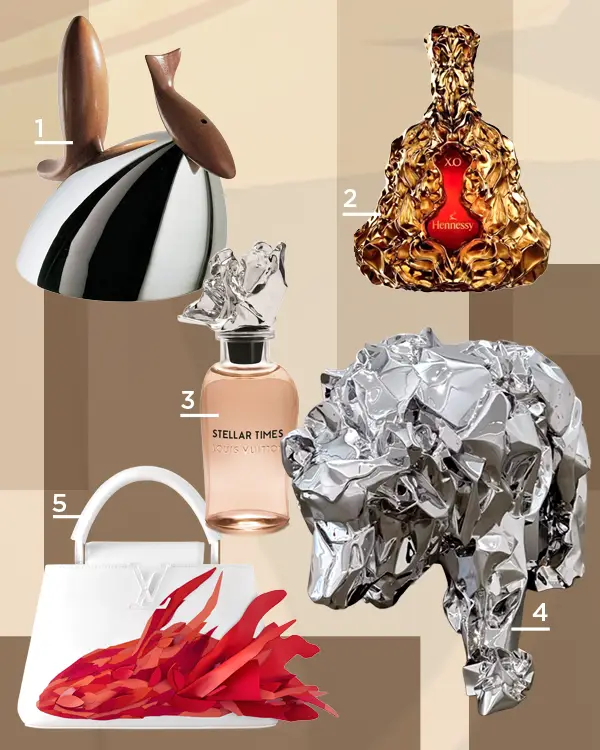
FRANK GEHRY: A FASCINATION WITH FLUID FORMS
1 Pito Tea Kettle 2 Hennessy X.O Decanter 3 Parfum Bottle for Louis Vuitton, Collaboration between Frank Gehry and Jacques Cavallier Belletrud 4 “Bear With Us” Sculpture in Stainless-Steel 5 Gehry’s Handbag for Louis Vuitton’s Capsule Collection
Frank Gehry’s work beyond architecture proves that his creative vision was never limited to buildings alone. From Easy Edges furniture and the Wiggle Chair to ColorCore Fish Lamps, Snake Lamps and sculptural objects, Gehry explored how material, light and form could reshape everyday life. Each piece carries the energy of his architecture in a more personal scale, offering design that is tactile, imaginative and unmistakably Frank Gehry.
Making Beauty: The Tea Kettle, the Decanter and the Luxury Years
Gehry’s gift for turning the ordinary into the poetic produced one true mass-market icon: the Pito tea kettle for the Italian housewares company Alessi, designed in the late 1980s and manufactured from 1992, the only kettle he ever created for the firm. Its mirror-polished stainless-steel body curves like a surging wave and its mahogany handle and whistle take the shape of two fish darting out of the water. When the water boils, steam through the whistle produces a sound Alessi compared to a whale’s song. A simple kitchen utensil became, in his hands, a functional sculpture for the stovetop that still sits beautifully in a home today.
Later in Frank’s career, luxury brands sought out his unrivaled creative vision. For Hennessy’s 150th anniversary in 2020, Gehry reimagined the X.O cognac decanter in crinkled, gold-dipped bronze, housed within a fractured glass glorifier evoking water and light. For Louis Vuitton, he designed a fish-inspired bottle for the Les Extraits fragrance collection. In 2021, Gehry designed a capsule collection of handbags for Art Basel Miami Beach; in 2023, he reinterpreted the iconic Capucines bag and designed the transparent Tambour Moon watch, which echoes his glassy Fondation Louis Vuitton building in Paris.
Celebrating Gehry’s Unexpected Style
These design objects and furniture pieces were more than an architect’s hobby. For Frank Gehry, the cardboard chair, the woven maple armchair, the crocodile lamp, the fish-shaped kettle and the titanium museum were all expressions of a single sensibility: a delight in unexpected materials, a fascination with the fluid forms of living things and a refusal to let function erase beauty.
At Beyond Shelter Real Estate Group, we spend our days inside homes where design history lives in the details, so Gehry’s object work is close to our hearts. Great design is not confined to the walls of a house; it lives in the chair you choose, the lamp that glows in the evening and the tea kettle on the stove. Whether shaping a building you could walk through or an object you could hold in one hand, Frank Gehry was always doing the same thing. He was making sculptures and inviting all of us to look at our homes and environments with a little more wonder.
Ready to find a Los Angeles home worthy of your most distinctive design pieces? Beyond Shelter Real Estate Group specializes in architecturally significant properties that let collector-quality furniture and art shine, from Mid-Century Modern and architect-designed residences, such as those by Frank Gehry, to historic Spanish Revival homes and luxury estates. Whether you’re buying a character-rich property or selling a one-of-a-kind home, our team understands what makes these spaces extraordinary. Connect with Beyond Shelter today and discover how we help our clients live beyond!
Subscribe to our “Live Beyond NOW” newsletter below for handpicked listings of distinctive Los Angeles homes plus fresh design and architecture inspiration delivered straight to your inbox.