Frank Gehry Architecture: A Residential Legacy of Innovation and Iconic Design
Frank Gehry: Architect Profile
- Born: February 28, 1929, Toronto, Ontario, Canada (born Frank Owen Goldberg)
- Died: December 5, 2025, Santa Monica, California (aged 96)
- Citizenship: Canadian-American
- Education: University of Southern California, B.Arch (1954); Harvard Graduate School of Design, urban planning (1956-1957, did not complete)
- Style: Deconstructivism, Postmodernism, sculptural modernism
- Practice: Gehry Partners, LLP (Los Angeles)
- Known For: Sculptural forms, fragmented geometries, exposed structure, and the elevation of everyday materials such as corrugated metal, plywood, chain-link, and asphalt shingles into serious architecture
- Key Project Locations: Los Angeles, Bilbao, Paris, New York, Prague, Berlin, Minneapolis, Seattle, Miami, Sydney, Hong Kong, Arles, Panama City
- Notable Works: Guggenheim Museum Bilbao (1997), Walt Disney Concert Hall (2003), Fondation Louis Vuitton (2014), 8 Spruce Street (2011), Dancing House Prague (1996), Gehry Residence (1978), Vitra Design Museum (1989)
- Influences: Frank Lloyd Wright, Le Corbusier, Harwell Hamilton Harris, Balthasar Neumann, Japanese architecture and spatial concepts, the vernacular buildings of working-class Queens and Los Angeles
- Awards and Honors:
- Arnold W. Brunner Memorial Prize in Architecture, American Academy of Arts and Letters (1977), Pritzker Architecture Prize (1989), Wolf Prize in Art, Wolf Foundation (1992), Praemium Imperiale, Japan Art Association (1992), Dorothy and Lillian Gish Award for lifetime contribution to the arts (1994), National Medal of Arts (1998), American Institute of Architects Gold Medal (1999), Royal Institute of British Architects Gold Medal (2000), Gold Medal for Architecture, American Academy of Arts and Letters (2002), Companion of the Order of Canada (2002), Order of the Legion of Honor, France (2006), Presidential Medal of Freedom (2016), More than 25 national and regional AIA Awards
- Archive: The Frank Gehry Papers are held at the Getty Research Institute, Los Angeles, which acquired the architect’s archive in 2017. The collection includes drawings, models, correspondence, and project records for the Danziger Studio, Davis Studio, Benson House, Sirmai-Peterson House, Schnabel House, and many other projects.
Long before the Guggenheim Bilbao or Walt Disney Concert Hall, Gehry was experimenting with form, fragmentation and humble materials in a series of houses built across Los Angeles and beyond.
For architectural collectors and design-led home buyers, Gehry’s residential work offers an unmatched study in spatial innovation and material honesty. Gehry’s houses in Los Angeles have become some of the most coveted properties in the architectural collecting world. At Beyond Shelter, we specialize in helping clients discover and acquire architecturally significant properties, including works by iconic architects like Gehry.
In This Article
- About Frank Gehry: Early Life And Career
- The Gehry Philosophy and Deconstructivist Architecture
- Early Recognition: The Danziger Studio and Residence
- The Davis Studio and Residence: First Sculptural Breakthrough
- The Benson House: Where Constraint Became Creative Force
- Venice Inventions: The Spiller House and Norton House
- The Village Concept: Sirmai-Peterson and Winton Guest House
- The Schnabel House: Refining a Residential Vocabulary
- Beyond Architecture: Furniture, Fish Lamps, and Rebecca’s Restaurant
- Collecting Gehry: Why Architectural Collectors Pursue These Homes
- FAQs About Frank Gehry’s Residential Architecture
About Frank Gehry: Early Life and Career
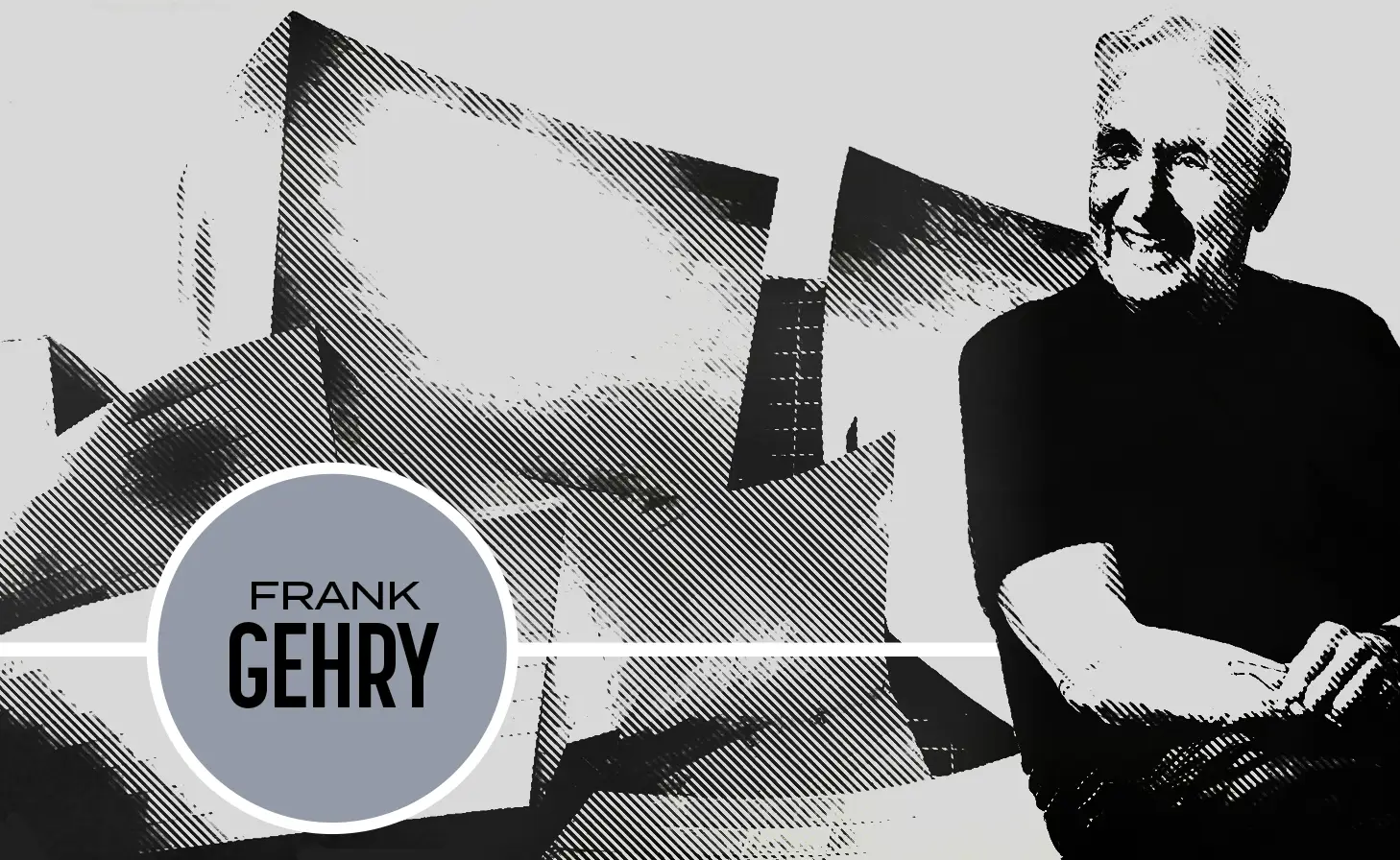
Few buildings have transformed the skyline of Los Angeles quite like the Walt Disney Concert Hall. Wrapped in luminous stainless-steel curves, Frank Gehry turned a civic landmark into a work of sculpture, capturing movement, light and imagination on every surface. More than a concert hall, it stands as a symbol of Los Angeles’ creative spirit and Gehry’s extraordinary ability to redefine what architecture can be.
The Gehry Philosophy and Deconstructivist Architecture
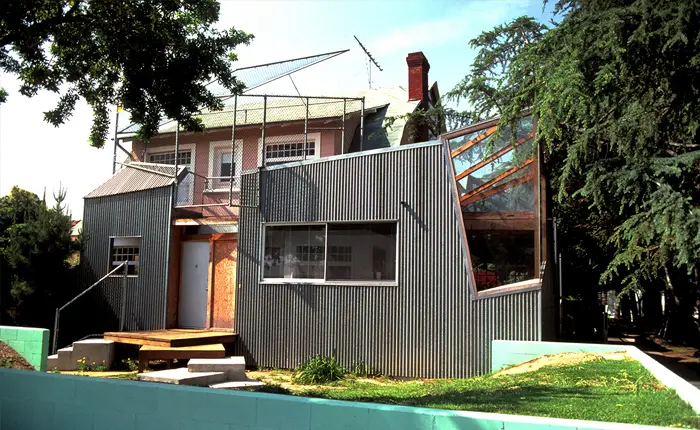
Gehry’s own Santa Monica residence, completed in 1978, became one of the earliest works often associated with deconstructivism. Wrapped around a 1920s Dutch colonial home, it announced a new vocabulary built from chain-link fencing and corrugated steel. Photo: Tim Street-Porter
Frank Gehry never set out to become a starchitect or architecture’s great iconoclast. Gehry’s philosophy came from a simple concept: architecture should serve human experience first and convention second. His residential work asks a single question: what if we stopped hiding structure and celebrated how buildings are actually made?
Gehry’s approach grew out of close attention to vernacular architecture, Japanese spatial concepts and the honest material traditions of working-class neighborhoods. From these influences, he developed a design language that values authenticity, spatial surprise and the poetic potential of ordinary materials such as plywood, asphalt shingles, chain-link and corrugated metal.
His residential projects are often grouped with deconstructivist architecture, a label cemented by the 1988 Museum of Modern Art exhibition that featured his work alongside Zaha Hadid, Rem Koolhaas and Daniel Libeskind. For more on this movement and Gehry’s place within it, you can explore ArchDaily’s analysis of his residential work.
Early Recognition: The Danziger Studio and Residence
Completed in 1965 on a busy corner of Melrose Avenue in Hollywood, the Danziger Studio and Residence was Gehry’s first building to receive widespread attention. Commissioned by graphic designer Louis Danziger, the project combines a 1,000-square-foot studio and a 1,600-square-foot townhouse in a single composition built from two offset stucco cubes that frame a private courtyard
The design responded directly to its noisy commercial context. Gehry and his collaborator Greg Walsh enclosed the volumes almost entirely, opening minimal windows to the street and turning the building inward. The result was a quiet, late-modernist retreat carved into the chaos of Hollywood. The architectural historian Reyner Banham later highlighted the Danziger Studio and Residence in his influential book on Los Angeles architecture, recognizing the project as a significant statement of restraint and simplicity.
The Danzigers occupied the home for 30 years and the building is now a designated cultural landmark. It marks the earliest expression of Gehry’s lifelong interest in pulling apart a single program into distinct, related volumes, an idea he would later develop with much greater complexity.
The Davis Studio and Residence: First Sculptural Breakthrough
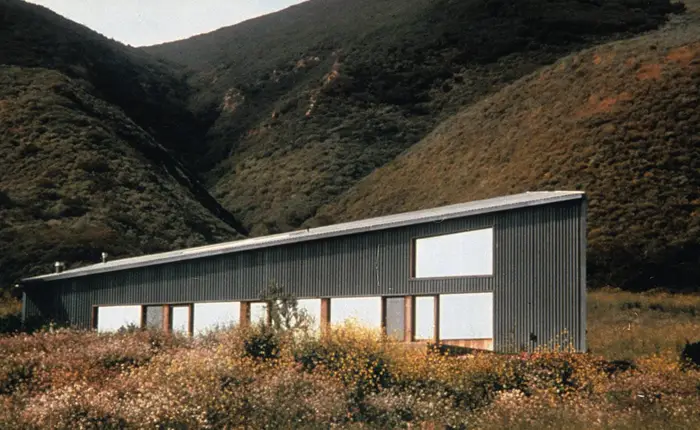
Designed in 1968 and completed in 1972, the Davis House and Studio introduced corrugated galvanized steel as a serious architectural material. It also became known as the “Tin House” and was famously owned by actor Patrick Dempsey starting in 2009. Archival Photo:irondavis.com
The Davis House and Studio, designed in 1968 and completed in 1972, marked Gehry’s first truly sculptural building. Painter Ronald Davis commissioned a combined home and studio on a three-and-a-half-acre pastoral site near Zuma Beach in Malibu. Davis was working on perspectival paintings at the time and the resulting structure became a study in geometric distortion.
For Davis, Gehry designed a single trapezoidal shed clad in corrugated galvanized steel and exposed plywood, with a sloping roof following a forced perspective. The building reads like a barn at first glance, then reveals its strange angles and unexpected proportions on closer inspection. Gehry described his approach to Davis bluntly: “I built the most beautiful shell I could do and then let him bring his things and turn it into use.”
Gehry later said the Davis project “unlocked a host of possibilities for me.” This was the moment when his interest in inexpensive industrial materials, raw construction and sculptural geometry first crystallized into a coherent residential vision.
The Benson House: Where Constraint Became Creative Force
In 1981, Gehry completed the Benson House in Calabasas, a project he called “one of my all-time favorite projects because the budget was so tight and so impossible.” The clients, Loyola Law School professor Bob Benson and his wife Lesley, a schoolteacher, offered Gehry something more valuable than money: complete creative freedom. “We were hiring his creativity,” Benson recalled, “and we were convinced he was a creative genius.”
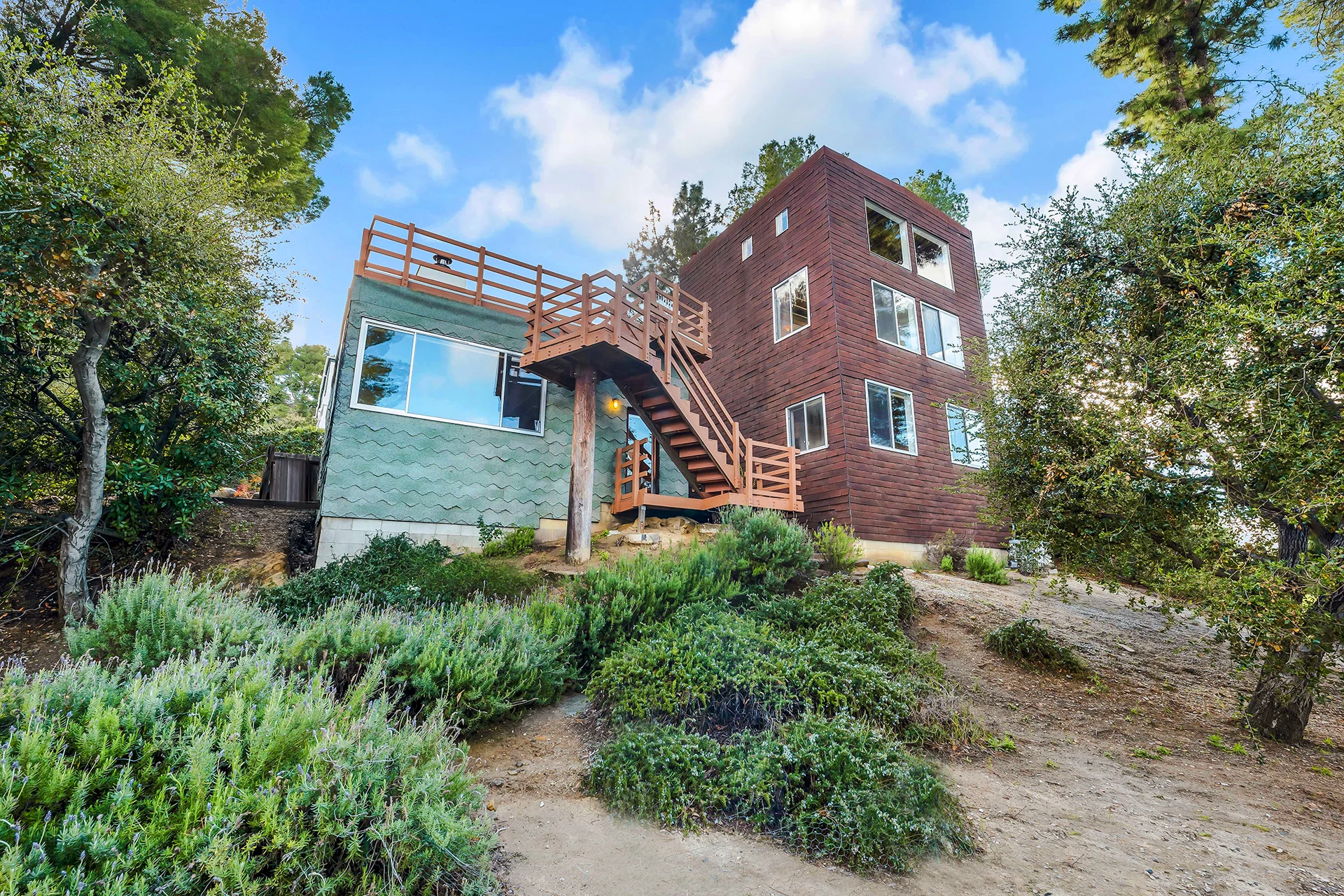
The steep hillside site required a retaining wall. Rather than building against it, Gehry separated the house from the slope, inserting a moat of dynamic negative space between structure and earth. He then split the program into two distinct vertical volumes joined by a vertebra-like wooden walkway. Volume One holds the bedrooms and private retreat areas. Volume Two contains the living and gathering spaces. Both are clad in asphalt shingles, a material Gehry traced to the working-class houses of Queens he had glimpsed from the highway as a young man.
Gehry described the logic of the design in sculptural terms: “How would you like two houses here? Almost touching. It is like a Japanese sculpture, when you have two stones almost touching.” By breaking the building into shorter, simpler spans, he dramatically reduced construction costs while producing an architecture of remarkable conceptual depth. The Benson House is archived at the Getty Research Institute as an important early work.
Venice Inventions: The Spiller House and Norton House
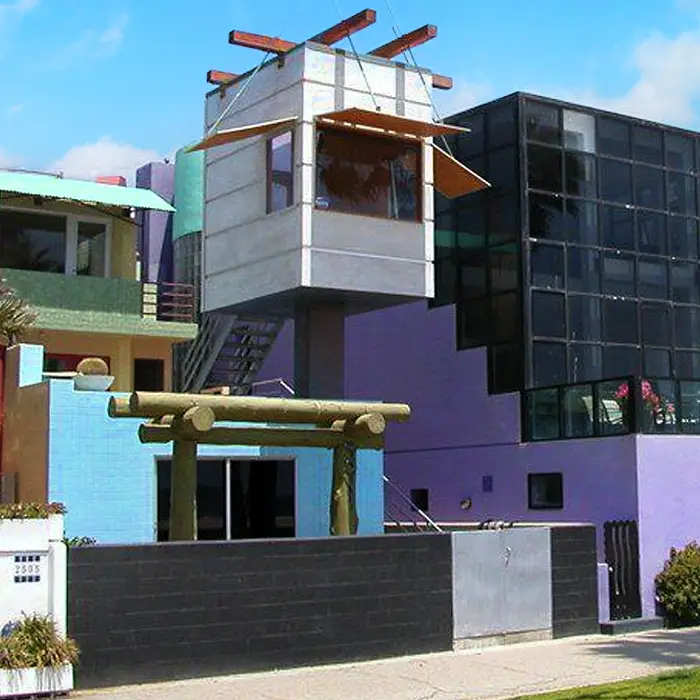
Completed in 1984, the Norton House on Ocean Front Walk in Venice features a tongue-in-cheek lifeguard-tower studio that pays homage to William Norton’s earlier career as a beach lifeguard.
Two Venice projects from the early 1980s show Gehry pushing his residential ideas in dense urban beach settings. The Spiller House, completed in 1980 for filmmaker Jane Spiller, occupies a narrow lot just steps from the sand. Gehry split the program into two volumes wrapped in corrugated galvanized metal: a two-story rental apartment in front and a four-story owner’s residence behind. Exposed wood framing and shifting skylights give the interior a deliberate sense of being still under construction, a quality Gehry returned to again and again.
The Norton House, completed in 1984 for screenwriter William Norton and artist Lynn Norton, sits directly on the Venice Boardwalk. Gehry stacked offset volumes faced in concrete block, stucco, glazed tile and timber logs in shades of sky blue, green, yellow, orange and red. The defining feature is a tiny studio perched on a post in front of the main house, a one-room writing perch with panoramic ocean views. Gehry designed it as a tongue-in-cheek tribute to William Norton’s earlier work as a Los Angeles lifeguard. He called it “my pride and joy.”
The Village Concept: Sirmai-Peterson and Winton Guest House
By the mid-1980s, Gehry had developed a residential strategy that he and others described as the village concept. Rather than organizing a home as a single hierarchical envelope, he broke the program into separate functional buildings clustered like a small village. Two projects bring this idea to its fullest expression.
The Sirmai-Peterson House in Thousand Oaks, commissioned in 1983 and completed in 1988, is set on a secluded oak-studded hillside northwest of Los Angeles. Gehry and Greg Walsh treated each room as its own building, each with distinct geometry and material expression. These volumes are arranged around a central courtyard in a loose composition that reads as both spatially complex and intuitively legible. Smooth stucco, galvanized metal and concrete block define the exterior, while exposed wood structure and unfinished plywood appear inside.
The Winton Guest House, designed for Mike and Penny Winton between 1983 and 1987, takes the village concept to a poetic extreme. Sited on a Lake Minnetonka property in Wayzata, Minnesota, that already held a 1950s Philip Johnson house, Gehry composed the guest house as a cluster of small elemental volumes. A black-painted metal pyramid contains the living room. A brick volume holds the fireplace room. A curving stone bedroom uses dolomitic limestone from a Minnesota quarry. The project won the first House and Garden Design Award for Architecture in 1987 and was named one of the best buildings of the decade by Time magazine. It was relocated in 2011 and again in 2016 to the Hudson Valley in New York.
The Schnabel House: Refining a Residential Vocabulary
Commissioned in 1986 and completed in 1989, the Schnabel House for Marna and Rockwell Schnabel in the Brentwood area of Los Angeles represents one of the most resolved expressions of Gehry’s residential thinking. By this point, he had refined the village concept into a sophisticated planning strategy capable of organizing a substantial home on a generous lot in one of LA’s most desirable westside neighborhoods.
The plan disperses the home’s rooms across the site as a constellation of independent forms, including a copper-clad volume, a domed library and a guest pavilion seemingly floating on a small reflecting pool. Each piece has its own roofline, its own material identity and its own relationship to the landscape and the central garden. Movement between volumes becomes ceremonial. Daily life unfolds as a sequence of distinct architectural experiences, much as it does in the Benson House and the Sirmai-Peterson House, but on a larger, more luxurious scale.
The Schnabel House is widely regarded as one of the most important late-1980s American houses and an essential reference for any conversation about contemporary architectural home styles in Los Angeles.
Beyond Architecture: Furniture, Fish Lamps, and Rebecca’s Restaurant

Gehry’s design work has always crossed disciplines. The Wiggle Side Chair from the 1969-1973 Easy Edges series and the Fish Lamps first produced in the mid-1980s both turn humble industrial materials into collectible objects.
Gehry’s residential work runs alongside an equally important body of furniture, lighting and interior design. Between 1969 and 1973, he produced Easy Edges, a furniture series made entirely from laminated corrugated cardboard. Pieces such as the Wiggle Side Chair, the Side Chair and the Body Contour Rocker are surprisingly sturdy, comfortable and quiet, briefly making Gehry famous as a furniture designer. He returned to cardboard with Experimental Edges between 1979 and 1982, then again with a series of bentwood pieces for Knoll between 1989 and 1992, including chairs named after his forever-loved game of ice hockey, like Power Play and Cross Check.
His Fish Lamps emerged from a 1983 commission by the Formica Corporation to design objects using its new plastic laminate, ColorCore. After accidentally shattering a sheet, Gehry began gluing the shards onto wire armatures shaped like fish, creating glowing sculptural lamps. The first Fish Lamps were fabricated between 1984 and 1986, and Gehry returned to the form repeatedly throughout his career.
Many of these objects converged at Rebecca’s, the restaurant Gehry designed for chef Bruce Marder in Venice, completed in 1985. The interior featured a pair of large illuminated crocodiles hanging from the ceiling, a chandelier in the form of a glowing octopus made of thousands of crystals and two large standing fish lamps. Gehry invited Los Angeles artists Ed Moses, Peter Alexander and Tony Berlant to contribute additional elements. Sadly, Rebecca’s was demolished in 1998 and its fixtures were dispersed at auction, but it remains a defining example of Gehry’s total approach to design.
Collecting Gehry: Why Architectural Collectors Pursue These Homes
For architectural collectors and design-led home buyers, Gehry’s residential portfolio occupies a unique position in the market. Three factors drive collector interest. The first is authenticity. These are original works by a Pritzker Prize laureate, created during the formative decades of one of the most influential architectural careers of the modern era.
The second is scarcity. Gehry completed a relatively small number of single-family homes and many of them remain in long-term ownership or have been quietly traded between collectors. The Davis Studio, the Norton House, the Sirmai-Peterson House, the Benson House and the Schnabel House have all changed hands from their original owners; several have appeared on the market at significant valuations in recent years. The Davis Studio was tragically destroyed in Malibu’s 2018 Woolsey Fire.
The third is intellectual significance. Each of these residences represents a step in the evolution of Gehry’s thinking about space, material and the relationship between architecture and lived experience. The Getty Research Institute has archived major portions of Gehry’s residential papers, including the Benson House, Davis House and Sirmai-Peterson House, recognizing their importance to American architectural history. Owning a Gehry residence means becoming the steward of an idea that continues to influence contemporary design.
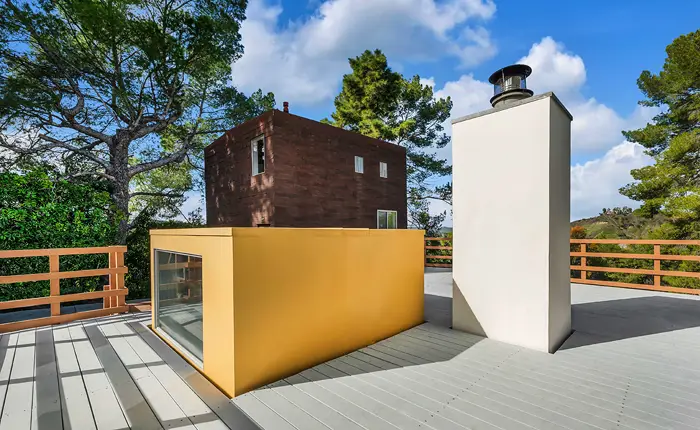
Frank Gehry designed The Benson House for Bob and Lesley Benson in the hills of Calabasas. After Bob Benson was instrumental in securing Gehry’s commission for the Loyola Law School in downtown Los Angeles, he asked the architect to design a home for his family on a limited budget, with unlimited creativity. Over more than five decades, Frank Gehry’s residential work redefined the language of the American house, from a modest Hollywood studio in 1965 to the village-like compositions of the late 1980s and to his furniture, lighting and interior design for projects like Rebecca’s restaurant.
Frank Gehry – Notable Projects and Houses
- Danziger Studio and Residence (1965) — Hollywood, Los Angeles, CA. Gehry’s first widely recognized building, two offset stucco cubes combining a 1,000 sf studio and 1,600 sf townhouse for graphic designer Louis Danziger. Inward-facing volumes shield the home from a busy Melrose Avenue corner. Praised by architectural historian Reyner Banham as a key Los Angeles work.
- Davis Studio and Residence (1968–1972) — Malibu, CA. Designed for painter Ronald Davis on a three-and-a-half-acre pastoral site near Zuma Beach. Trapezoidal shed clad in corrugated galvanized steel and exposed plywood, with a sloping roof following a forced perspective. Sometimes called the “Tin House,” it was previously owned by actor Patrick Dempsey.
- Gehry Residence (1978; expanded 1991–1994) — Santa Monica, CA. The architect’s own home was built by wrapping chain-link fencing, corrugated metal, and asymmetrical glass volumes around an existing 1920s Dutch colonial bungalow. Widely considered a foundational deconstructivist work and one of the most influential American houses of the 20th century.
- Loyola Law School (1978–2002) — Downtown Los Angeles, CA. A multi-building campus was completed in phases over more than two decades for the client, Bob Benson and the law school. Combines small classical-referencing structures with industrial materials, marking a critical commission in Gehry’s early institutional career.
- Spiller House (1980) — Venice, CA. Built for filmmaker Jane Spiller on a narrow lot near the beach. Two corrugated-metal-clad volumes contain a two-story rental apartment in front and a four-story owner’s residence behind, with exposed framing and shifting skylights inside.
- Benson House (1981) — Calabasas, CA. Asphalt-shingle-clad family home for Loyola Law School professor Bob Benson and his wife, Lesley. Two vertical volumes joined by a vertebrae-like wooden walkway, separated from the hillside by a moat of negative space. Gehry called it “one of my all-time favorite projects.” Archived at the Getty Research Institute.
- Norton House (1984) — Venice, CA. Built for screenwriter William Norton and artist Lynn Norton on Ocean Front Walk. Stacked offset volumes in concrete block, stucco, glazed tile, and timber logs with a tongue-in-cheek lifeguard-tower studio honoring William Norton’s earlier career as a beach lifeguard. Gehry called it “my pride and joy.”
- Rebecca’s Restaurant (1985) — Venice, CA. Complete interior design for chef Bruce Marder featuring illuminated hanging crocodiles, a glowing octopus chandelier of thousands of crystals, and large standing fish lamps. Included contributions from artists Ed Moses, Peter Alexander, and Tony Berlant. Demolished in 1998.
- Winton Guest House (1983–1987) — Wayzata, Minnesota. Designed for Mike and Penny Winton on a Lake Minnetonka property alongside a 1950s Philip Johnson house. A cluster of elemental volumes, including a black-painted metal pyramid, a brick fireplace room, and a curving stone bedroom in Minnesota dolomitic limestone. Won the first House and Garden Design Award for Architecture in 1987. Relocated to Owatonna, Minnesota, in 2011 and to the Hudson Valley in 2016.
- Sirmai-Peterson House (commissioned 1983, completed 1988) — Thousand Oaks, CA. Designed with Greg Walsh for Barbara Sirmai and Mark Peterson on a secluded oak-studded hillside. Each room is treated as its own building, clustered as a village around a central courtyard. Sold in 2026. Archived at the Getty Research Institute.
- Vitra Design Museum (1989) — Weil am Rhein, Germany. Gehry’s first European building and his first major sculptural museum. Curving white plaster forms departed sharply from his earlier industrial-material vocabulary and previewed the curvilinear language of later work.
- Schnabel House (commissioned 1986, completed 1989) — Brentwood, Los Angeles, CA. Built for Marna and Rockwell Schnabel. A constellation of independent forms, including a copper-clad volume, a domed library, and a guest pavilion that appears to float on a reflecting pool. Widely regarded as one of the most resolved expressions of Gehry’s village concept.
- Santa Monica Artist Loft (1992) — Santa Mionica, Los Angeles, CA. The six-unit creative complex was conceived through a collaboration between Frank Gehry and artist Chuck Arnoldi, who reserved Studio 2 as his personal space.
- Weisman Art Museum (1993) — University of Minnesota, Minneapolis, MN. Brushed stainless-steel facade tumbling toward the Mississippi River. The project served as a major proving ground for the curved metal cladding that would define Bilbao four years later.
- Dancing House (1996) — Prague, Czech Republic. Co-designed with Croatian-Czech architect Vlado Milunic. A pair of intertwining towers nicknamed “Ginger and Fred” for their dance-like composition. Gehry’s first major European urban commission.
- Guggenheim Museum Bilbao (1997) — Bilbao, Spain. Titanium-clad museum credited with revitalizing the post-industrial Basque city and launching the “Bilbao effect.” Often cited as the most important building of the late 20th century and a turning point in Gehry’s international career.
- Walt Disney Concert Hall (2003) — Downtown Los Angeles, CA. Home of the Los Angeles Philharmonic and Gehry’s signature Los Angeles project. Commissioned in 1988 and long delayed in construction, the stainless-steel sails and acoustically celebrated interior have made it one of the city’s most recognizable civic buildings.
- Jay Pritzker Pavilion (2004) — Millennium Park, Chicago, IL. Outdoor concert venue with a sweeping stainless-steel proscenium and a trellis of overhead speakers covering the Great Lawn. Centerpiece of Chicago’s Millennium Park.
- MIT Stata Center (2004) — Cambridge, MA. Academic complex for the Massachusetts Institute of Technology, housing the computer science, artificial intelligence, and linguistics departments. Fragmented colorful volumes embody the building’s interdisciplinary mission.
- 8 Spruce Street (2011) — Lower Manhattan, New York, NY. Gehry’s first residential skyscraper, a 76-story tower clad in rippling stainless steel. At completion, it was briefly the tallest residential building in the Western Hemisphere.
- New World Center (2011) — Miami Beach, FL. Home of the New World Symphony. Combines a flexible concert hall interior with a large outdoor projection wall used for free public broadcasts of performances.
- Fondation Louis Vuitton (2014) — Bois de Boulogne, Paris, France. The Contemporary Art Foundation was commissioned by Bernard Arnault and LVMH. Twelve sweeping glass sails enclose the gallery volumes, a structure Gehry called “a cloud of glass.”
- Dr Chau Chak Wing Building (2014) — University of Technology Sydney, Australia. Business school building with an undulating brick facade. Gehry’s first project in Australia.
- Pierre Boulez Saal (2017) — Berlin, Germany. Chamber music hall designed for the Barenboim-Said Akademie. The oval-shaped interior gives every seat an intimate view of the central stage.
- LUMA Arles (2021) — Parc des Ateliers, Arles, France. Twisting ten-story tower clad in stainless-steel panels, anchoring a cultural campus on a former industrial site in southern France. One of Gehry’s most ambitious late-career works.
Frequently Asked Questions About Frank Gehry’s Residential Architecture
Looking for a Frank Gehry Home for Sale in Los Angeles?
Finding and acquiring properties by iconic architects requires more than standard real estate experience. It demands deep architectural knowledge and a network that understands these unique works.
Beyond Shelter Real Estate Group combines expertise in architectural history with knowledge of the active real estate market to help collectors, investors and design-conscious buyers navigate the world of architecturally significant properties. Whether you are seeking an early Gehry residence, a classic mid-century modern property, a Spanish Colonial estate, or a contemporary architectural statement, our team provides the context, provenance research and market guidance needed to make informed decisions.
Explore Architectural Homes:
View Architectural Homes for Sale
Discover Modernist Homes:
Mid-Century Modern Homes in Los Angeles
Discover Los Angeles Neighborhoods:
Explore Los Angeles Neighborhoods
Service Areas: Los Angeles and Southern California
About Beyond Shelter Real Estate Group
Beyond Shelter Real Estate Group is a premier real estate group serving Los Angeles and Southern California. With deep expertise in modernist architecture, historic preservation and architectural history, we help clients discover and acquire architecturally significant properties. Our team combines architectural knowledge with real estate expertise to provide comprehensive guidance for design-conscious buyers, sellers and architecture enthusiasts. We specialize in mid-century modern, Spanish Colonial, Craftsman and contemporary architectural properties, representing a unique intersection of art, design and real estate market knowledge.