Harwell Hamilton Harris Architecture: California’s Organic Modernist Master
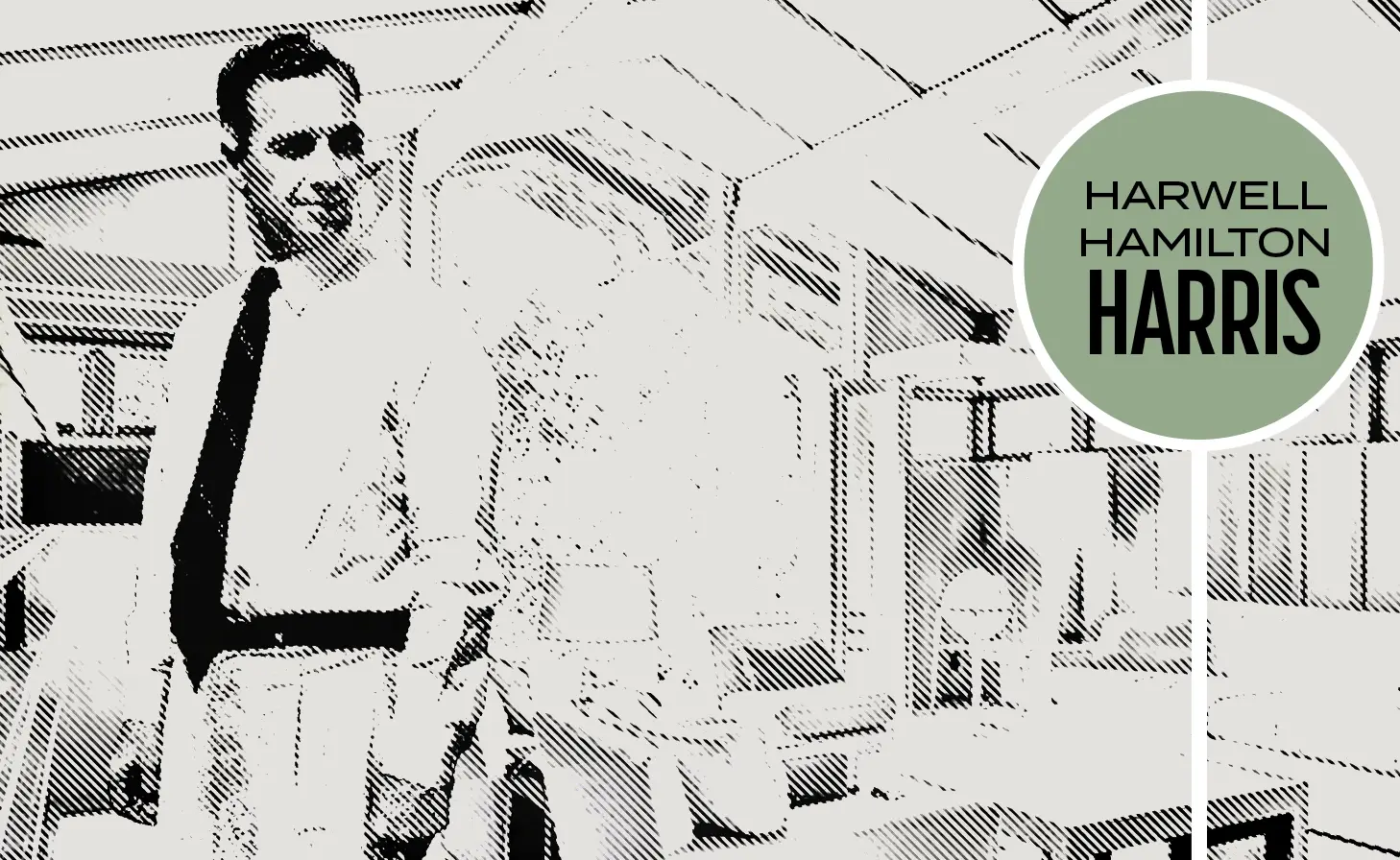
Harwell Hamilton Harris (1903 – 1990) was an American modernist architect and a founding voice of California Regionalism. Trained under Richard Neutra from 1928 to 1932, Harris established his independent practice in Los Angeles in 1933. His residential work is defined by exposed post-and-beam wood construction, low-pitched gable roofs with deep overhangs and seamless indoor-outdoor integration. Key projects include the Fellowship Park House, Los Angeles (1936) and the Weston Havens House, Berkeley (1940), considered his masterpiece and now a California Historic Landmark. From 1952 to 1955, Harris served as the founding dean of the School of Architecture at the University of Texas at Austin, where his faculty hires became known as the Texas Rangers. His papers are held at the Alexander Architectural Archive, UT Austin. Harris is associated with mid-century modern design, organic architecture and the Arts and Crafts tradition of Bernard Maybeck.
Harwell Hamiton Harris – Architect Profile
Born: July 2, 1903 — Redlands, California
Died: November 18, 1990 — Raleigh, North Carolina (age 87)
Education: Pomona College (1921); Otis Art Institute, Los Angeles (sculpture, 1923); Apprenticed under Richard Neutra (1928–1932)
Style: California Regionalist Modernism, Organic Architecture, Arts & Crafts-influenced Mid-Century Modern
Known For: Exposed post-and-beam wood construction; Low-pitched gable roofs with deep overhangs; Seamless indoor-outdoor integration; California Regionalism theory; Founding the “Texas Rangers” faculty at UT Austin
Key Project Locations: Los Angeles, CA – Altadena, CA – Pasadena, CA – Silver Lake, Los Angeles, CA – Berkeley, CA – Austin, TX – Dallas, TX – Fort Worth, TX – Raleigh, NC
Notable Work: Weston Havens House, Berkeley (1941); Fellowship Park House, Los Angeles (1935); Pauline Lowe House, Altadena (1934)
Honors and Awards: Fellow, American Institute of Architects (FAIA), 1965; Richard Neutra Medal for Professional Excellence, 1982; Honorary Doctorate, North Carolina State University, 1985; ACSA Distinguished Professor Award, 1986–87
Archive: Harwell Hamilton Harris Papers, Alexander Architectural Archive, University of Texas at Austin (3,874 drawings; 3,675 photographic images)
For anyone passionate about architectural history, design-forward real estate, or the rich legacy of California modernism, knowing about Harris is essential. His work bridges the organic philosophy of his mentor Frank Lloyd Wright, with the West Coast regionalism pioneered by his teacher Bernard Maybeck, producing homes that are as emotionally resonant as they are architecturally significant. Explore our collection of architectural homes for sale in Los Angeles to discover properties shaped by this extraordinary tradition.
Harwell Hamilton Harris (1903–1990) brought a deeply humanistic sensibility to California modernism, favoring wood, natural light and landscape integration over the stark geometry of European Internationalism. In the early decades of California’s modern movement, Harris championed an architecture grounded in regional expression. Timber structures, sheltered terraces and carefully framed views became hallmarks of his approach. His work laid an intellectual and aesthetic foundation for generations of architects shaping Southern California’s modern landscape.
Born in Redlands, California, in 1903, Harwell Hamilton Harris came to architecture through an unlikely route. He initially studied sculpture at the Otis Art Institute in Los Angeles before a fateful encounter with Frank Lloyd Wright’s work redirected his entire creative life. Captivated by Wright’s organic philosophy, Harris enrolled in Richard Neutra and Rudolph Schindler’s circle of influence, eventually training under Richard Neutra in 1928. Yet Harris never simply imitated his mentors, he synthesized their ideas through his own deeply Californian sensibility.Harris established his independent practice in Los Angeles in 1933, quickly distinguishing himself with residential commissions that emphasized warmth, craft and continuity with the natural environment. Unlike some of his contemporaries who embraced the cool precision of the International Style, Harris gravitated toward redwood, cedar and Douglas fir materials that aged gracefully, invited touch and softened the boundary between interior and exterior. His career spanned six decades and three states, but it was his California years, particularly the late 1930s through the 1950s, that produced his most celebrated and influential work.Harris passed away in 1990, leaving behind a legacy of approximately 200 projects. Though he never achieved the mainstream fame of Wright or Neutra, his reputation among architectural historians and design enthusiasts has grown steadily and his surviving homes are now prized as exceptional examples of mid-century California residential architecture.
The Influences That Shaped His Vision
To truly understand Harwell Hamilton Harris’s architecture, it’s important to examine the constellation of influences that shaped it. Harris absorbed ideas from multiple traditions simultaneously, weaving them into something distinctly his own.His earliest and most formative influence was Bernard Maybeck, the Arts and Crafts pioneer whose work in the San Francisco Bay Area demonstrated that regional materials and vernacular building traditions could coexist with architectural sophistication. Maybeck’s playful eclecticism and reverence for hand-craftsmanship left a permanent mark on Harris’s aesthetic sensibility. From Wright, Harris drew his commitment to organic architecture, the idea that buildings should grow from their sites as naturally as trees grow from soil and that structure, space and ornament should arise from a unified design logic.His time working alongside Richard Neutra gave Harris direct exposure to European modernism and an appreciation for disciplined spatial planning. But where Neutra embraced glass, steel and the machine aesthetic, Harris consistently chose to humanize modernism to make it tactile, warm and rooted in place. This tension between the rational and the romantic, the modern and the traditional, became the creative engine of his best work.Harris was also deeply influenced by Japanese architecture, particularly the way traditional Japanese design used modular wood construction, sliding screens and covered walkways to blur the distinction between inside and outside. This sensitivity to threshold, to the poetic moment of transition between shelter and landscape, runs through virtually everything he designed. Learn more about the home styles that define Los Angeles architecture and see how these traditions connect.
Defining Characteristics of Harris’s Design Language
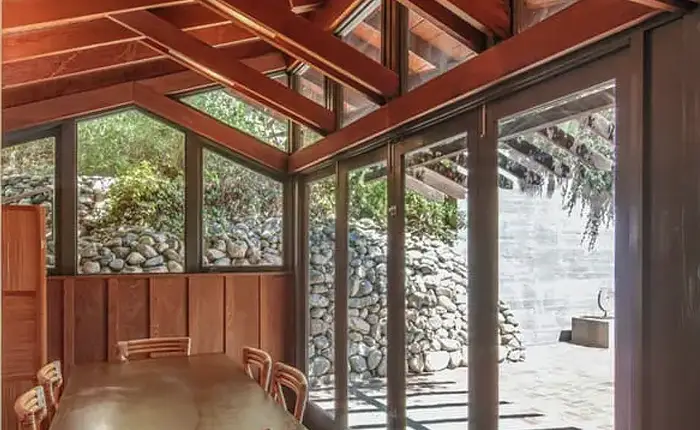
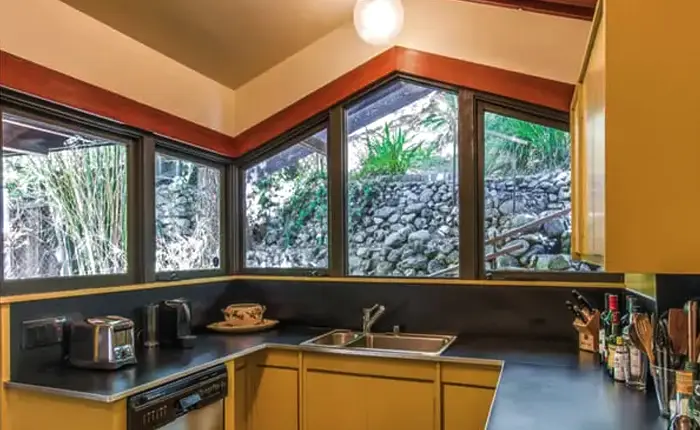
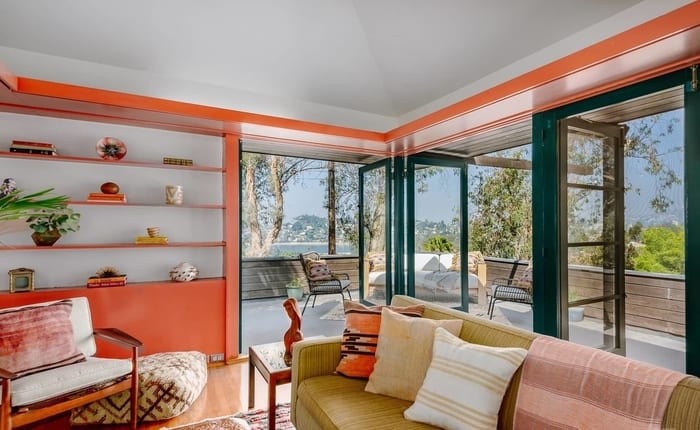
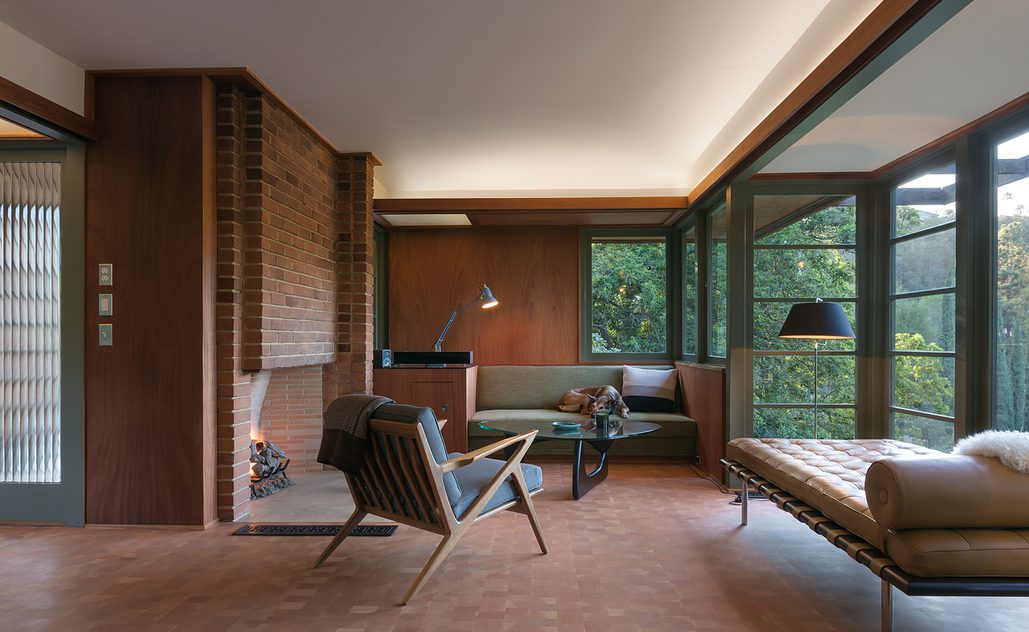
Harwell Hamilton Harris believed modern architecture should grow naturally from its surroundings. Wood, stone and carefully framed views connect his homes to their sites with remarkable sensitivity. The result is a warm and distinctly regional interpretation of modern design. Harris’s interiors are defined by the warmth of exposed wood, redwood, cedar and Douglas fir, carefully detailed to create rhythm and texture throughout the home.
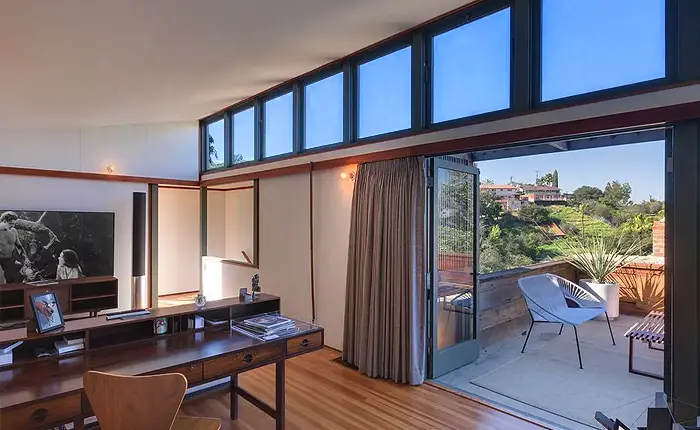
Spend time in a Harwell Hamilton Harris home and certain qualities announce themselves immediately. The first is wood not as cladding or veneer, but as structure, as ornament and as the essential organizing material of every space. Harris used exposed post-and-beam framing with an almost musical sense of rhythm, allowing structural members to become the decorative logic of a room. Ceilings in Harris homes often feature exposed rafters or board-and-batten paneling that create a sense of shelter without heaviness.Harris was also a master of the roof. His signature low-pitched gable roofs, often with generous overhangs, do double duty: they provide shade from California’s intense sun while simultaneously grounding the home in its landscape. The overhangs create covered transitional zones, porches, walkways and carports that extend living outward while protecting it from the elements. These covered outdoor spaces are among the most beloved features of Harris homes, offering shaded terraces that blur the line between interior comfort and outdoor freedom.Light in a Harris home is carefully choreographed. Rather than the expansive glass walls favored by Neutra or the Case Study architects, Harris preferred narrower, more deliberately placed windows, clerestories, corner glazing and shallow skylights that animate surfaces with moving light throughout the day without overwhelming the wood-paneled interiors. The result is a quality of light that feels intimate and alive rather than theatrical.Harris’s floor plans are notably free and open for their era, with living spaces that flow into dining and kitchen areas without the rigid room divisions of traditional domestic architecture. Yet these open plans never feel cold or institutional. The warmth of materials and the careful modulation of ceiling heights ensure that each zone retains its own character and sense of enclosure.
Iconic Harris Homes in Los Angeles
Los Angeles contains several of Harris’s most historically significant residential works, scattered across neighborhoods from the Hollywood Hills to Bel Air. Each represents a slightly different facet of his evolving design philosophy.
The Fellowship Park House (1935)
Designed with Gregory Ain and built for Harris himself in the Fellowship Park neighborhood of Los Angeles, this modest early home is often cited as the project that announced his independent voice. Perched on a steep hillside lot, the house uses a system of wood posts and beams to navigate the challenging topography, creating a series of linked platforms that step down the slope. The Fellowship Park House established several motifs that Harris would refine throughout his career: the integration of structure and ornament, the celebration of the hillside condition rather than its erasure and the use of covered outdoor spaces as extensions of interior living. It is recognized today as a Los Angeles Historic-Cultural Monument.
The Weston Havens House, Berkeley (1940)
Though technically in the Bay Area, the Havens House is so central to understanding Harris that no discussion of his work is complete without it. Commissioned by John Weston Havens Jr., the last direct descendant of Berkeley founder Francis Kittredge Shattuck, the house is widely considered Harris’s masterpiece, a sprawling, asymmetrical composition of redwood and glass that seems to grow organically from its spectacular hilltop site overlooking San Francisco Bay. The Havens House has been featured in numerous architectural histories and was designated a California Historic Landmark. ArchDaily has extensively documented its significance in the canon of West Coast modernism.Back in Los Angeles, Harris completed significant residential commissions in Silver Lake, Bel Air and the Hollywood Hills through the 1940s and early 1950s. Many of these homes remain in private hands, treasured by their owners and recognized by local preservation organizations. Browse our Los Angeles neighborhood guide to learn which areas contain the highest concentrations of architecturally significant mid-century homes.
Harris and the California Regionalist Movement
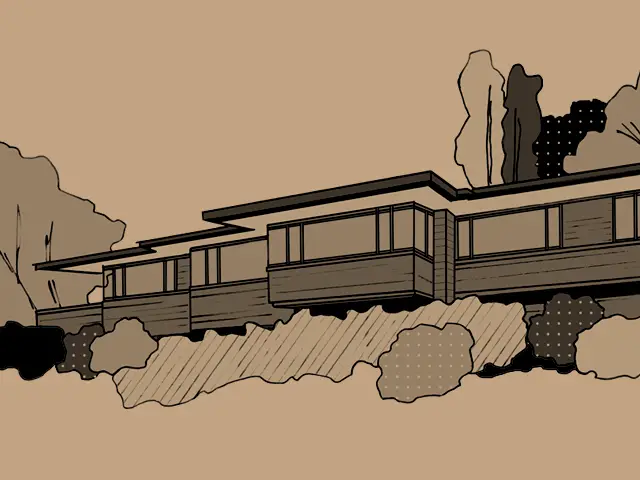
Harris’s hillside homes demonstrate his signature approach to challenging topography, working with the slope rather than against it and using covered outdoor spaces to extend living into the landscape.
Harris articulated one of the most important distinctions in mid-century design theory. He argued that there were two fundamentally different types of freedom in architecture: the freedom of indifference, which rejects the past without replacing it with anything meaningful and the freedom of a new integration, which synthesizes tradition, climate, materials and culture into something genuinely new. This framework became the theoretical foundation of what critics later called California Regionalism.California Regionalism, as Harris defined and practiced it, was not nostalgia. It was not a retreat into historical pastiche or a rejection of modernism’s spatial innovations. Rather, it was an insistence that modernism must be inflected by place, that a house in the hills above Los Angeles should look and feel different from a house in Chicago or Vienna, because the light is different, the climate is different, the landscape is different and the cultural expectations of daily life are different.This philosophy placed Harris in productive tension with the International Style purists of his era, who believed that the correct modern architecture was a universal one, applicable anywhere on the globe. Harris’s counterargument that universalism produces placelessness and that placelessness is a form of architectural failure has only grown more persuasive with time. His ideas resonate powerfully with contemporary sustainable design movements, which similarly emphasize climate responsiveness, locally sourced materials and regional building traditions. For more on the styles that defined Los Angeles residential architecture, visit our mid-century modern homes guide.
Later Career: Texas and the National Stage
In 1951, Harris made a surprising career pivot: he accepted the deanship of the School of Architecture at the University of Texas at Austin, relocating from California to lead one of the nation’s most ambitious architectural education programs. His tenure in Austin, which lasted until 1955, was both productive and controversial. Harris recruited a faculty that included Colin Rowe and Bernhard Hoesli, whose influence on the school became so transformative that architectural historians now refer to the period as the Texas Rangers era, a moment when American architectural education was fundamentally reimagined.During his Texas years and in the decade that followed, Harris continued to produce residential work, including commissions in Dallas, Fort Worth and across the Southwest. These later houses demonstrate a continued evolution of his design language; the wood construction and organic sensibility remain, but the plans become somewhat more open and the detailing slightly more restrained, reflecting both his clients’ preferences and the broader cultural shifts of the late 1950s and 1960s.In 1962, Harris relocated to Raleigh, North Carolina, where he reestablished his architectural practice and joined the faculty at North Carolina State University. He retired from teaching in 1973, yet continued designing from his home studio in Raleigh until shortly before his passing in 1990. His writings on regionalism, craft and the ethics of architectural practice have been collected and studied by scholars and remain valuable reading for anyone interested in the theoretical underpinnings of mid-century American design. Dezeen has explored how his regionalist philosophy continues to influence contemporary architects worldwide.
The Enduring Legacy of Harwell Hamilton Harris
In the work of Harwell Hamilton Harris, modernism finds a deeply human voice. His homes balance thoughtful geometry with natural materials, creating spaces that feel both modern and timeless. Wood, stone, and carefully framed views connect his homes to their sites with remarkable sensitivity. The result is a warm and distinctly regional interpretation of modern design.
Harris’s influence on subsequent generations of California architects has been substantial, if sometimes underacknowledged. His insistence on warmth, craft and regional specificity provided an alternative model to the glass-and-steel minimalism that dominated architectural culture in the postwar decades and that alternative model has proven increasingly attractive as contemporary designers grapple with questions of sustainability, local identity and human comfort.Today, Harris’s surviving homes are recognized by preservationists, collectors and design enthusiasts as among the most significant residential works produced in California during the twentieth century. Several have been designated historic landmarks at the city, state, or national level. The Harwell Hamilton Harris Papers are held at the University of Texas at Austin’s Alexander Architectural Archive, where researchers continue to study his drawings, correspondence and theoretical writings.The market for architecturally significant mid-century homes has grown substantially in recent years and when they come to market, Harris properties attract serious attention from buyers who understand the depth and history they represent. Unlike some mid-century modern homes that have been compromised by unsympathetic renovations, the best Harris houses retain their original character: the exposed wood structure, the carefully placed windows, the seamless connection to outdoor space. These are homes that were built to be lived in and they remain extraordinarily livable today. Our team at Beyond Shelter specializes in helping clients navigate the acquisition of architecturally significant homes across Southern California.
Finding and Buying a Harris Home Today
Harwell Hamilton Harris’ homes rarely appear on the open real estate market and when they do, they often sell quickly or are sold in off-market deals. Defining what you’re looking for before beginning your search is essential.The first challenge is identification. Not all Harris homes are well-documented and some have been altered significantly since their original construction. Working with a real estate team with deep knowledge of architectural properties is important: you need professionals who can read original drawings, assess the integrity of surviving materials and details, and evaluate the significance of any modifications made over the decades. Beyond Shelter’s team combines real estate expertise with genuine architectural literacy.From a practical standpoint, buyers should also understand that historic homes, even beloved ones, come with specific maintenance considerations. Wood-framed construction requires regular attention to prevent moisture intrusion and wood deterioration. Original windows and doors may need restoration or careful replacement. Mechanical systems in homes from the 1940s and 1950s have typically been updated and buyers should conduct thorough inspections to understand what remains original and what has been replaced.The rewards, however, are commensurate with the effort. A well-preserved Harris home offers something that new construction simply cannot replicate: the experience of living inside a genuine work of art, shaped by a master architect whose ideas about shelter, beauty and the relationship between humans and the natural world were decades ahead of their time. For buyers ready to invest in that experience, we believe the search is absolutely worth it. Contact our team through the Beyond Shelter contact page to begin your architectural home search, or explore our Los Angeles real estate team to learn more about our expertise.
Frequently Asked Questions About Harwell Hamilton Harris Architecture
/
Harwell Hamilton Harris
ARCHITECT
A Harwell Hamilton Harris home embodies the quiet ideals of California regionalism, in which wood, stone and careful siting respond gracefully to the climate and landscape. The result is architecture that feels grounded, timeless and deeply connected to place.
Harwell Hamilton Harris (1903–1990) was a California-born architect widely recognized as a pioneer of West Coast regionalist modernism. Trained under Richard Neutra and deeply influenced by Frank Lloyd Wright and Bernard Maybeck, Harris developed a humanistic approach to modern residential design that emphasized natural wood construction, generous roof overhangs and seamless integration with the landscape. His practice, centered in Los Angeles from 1933, produced approximately 200 built works across California, Texas and the Southeast.
What are the defining characteristics of Harwell Hamilton Harris architecture?
Harris homes are defined by exposed post-and-beam wood construction, low-pitched gable roofs with deep overhangs and a warm, tactile material palette of redwood, cedar and Douglas fir. His floor plans are open and flowing, while carefully placed windows, clerestories, corner glazing and skylights animate interiors with dynamic natural light. Covered outdoor spaces, including porches and walkways sheltered beneath the extended roofline, are a signature feature, blurring the boundary between interior living and the surrounding landscape.
What is Harwell Hamilton Harris’s most famous building?
The Weston Havens House in Berkeley, California (1940) is widely considered Harris’s masterpiece. Perched on a dramatic hilltop site overlooking San Francisco Bay, the house is a sprawling redwood-and-glass composition that exemplifies his organic regionalist philosophy. It has been designated a California Historic Landmark and is extensively documented in architectural histories. In Los Angeles, his 1935 Fellowship Park House, his own residence, is recognized as a Los Angeles Historic-Cultural Monument.
How does Harwell Hamilton Harris differ from Richard Neutra and Rudolf Schindler?
While Neutra and Schindler embraced the machine aesthetic of European modernism, flat roofs, steel frames and extensive glass, Harris consistently humanized the modern house through natural materials and craft. Where Neutra’s homes feel precise and cool, Harris’s feel warm and handmade. Where Schindler’s designs are spatially experimental, Harris’s are spatially generous but materially grounded. Harris drew from the Arts and Crafts tradition of Bernard Maybeck as much as from European modernism, producing homes that feel distinctly Californian rather than internationally derived.
Where can I learn more about Harwell Hamilton Harris and his architecture?
The primary archive of Harris’s work is the Harwell Hamilton Harris Papers at the Alexander Architectural Archive, University of Texas at Austin, which holds his drawings, correspondence and writings. Esther McCoy’s book “The Second Generation” (1984) includes an important early assessment of his work. Lisa Germany’s monograph “Harwell Hamilton Harris” (1991) remains the definitive scholarly study.
What is California Regionalism and how did Harris define it?
California Regionalism is an architectural philosophy that insists modern design must be shaped by local climate, materials, landscape, and culture rather than applied as a universal style. Harris articulated this idea, distinguishing between the “freedom of indifference” (rejecting tradition without replacing it) and the “freedom of a new integration” (synthesizing modernism with regional specificity). Harris argued that architecture rooted in place produces more livable, meaningful and lasting buildings than architecture that could exist anywhere.
Looking for a Harwell Hamilton Harris Home for Sale in Los Angeles?
Beyond Shelter specializes in exactly the kind of homes Harwell Hamilton Harris dedicated his life to creating.Whether you’re searching for a Harris original, a Neutra, a Schindler, or another architecturally significant mid-century property in Southern California, our team has the knowledge to guide your search. We combine real estate expertise with genuine architectural literacy to help design-conscious buyers find iconic architectural homes.Browse Properties:Mid-Century Modern Homes for Sale in Los AngelesExplore Architectural Homes:Architectural Homes for SaleService Areas: Los Angeles and Southern CaliforniaStart Your Architectural Home Search with Beyond Shelter →
About Beyond Shelter
Beyond Shelter is a premier architecture and real estate firm serving Los Angeles and Southern California. With a deep expertise in modernist architecture, historic preservation and architectural design, we help clients discover and acquire architecturally significant properties. Our team combines architectural knowledge with real estate expertise to provide comprehensive guidance for design-conscious buyers, sellers and architecture enthusiasts.Learn more about our services →
Los Angeles became a hub of post-war design and experimentation as visionary architects reshaped residential living. Their steel-and-glass homes, post-and-beam structures, sliding walls and expansive windows embraced natural materials, open floor plans and Southern California’s indoor-outdoor lifestyle.