Following World War II, Robert Brown (Brown Jordan) sought to introduce a product utilizing reclaimed materials. Collaborating with well-known designer, Walter Lamb, these modern prototypes were crafted utilizing bronze and copper tubing salvaged from sunken naval ships at Pearl Harbor. Lamb’s’ signature ultra-cool curvy furniture pieces, lounge chairs, dining tables, benches and more, combine extruded metal frames with hand-wrapped, marine-grade, cording that is flexible enough to provide comfort but strong enough to withstand the elements. The bronze or copper frames do not rust and will develop a beautiful patina over time.
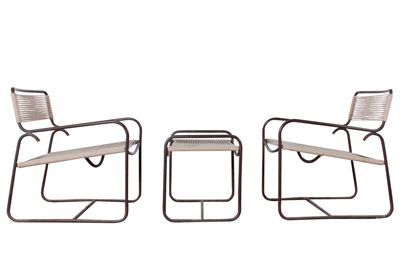
A signature pair of Lamb’s bronze lounge chairs with matching ottoman. Lamb’s collection for Brown Jordan is synonymous with cool California design and has been recognized with a MoMA design award.
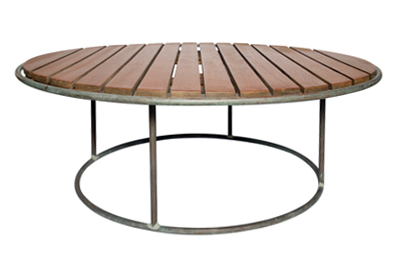
Lamb’s outdoor coffee table has a bronze tubular frame and is finished off with a redwood top. The result is a gorgeous contrast between the industrial-metal frame and the natural wood top.
As an innovator and influencer Gio Ponti, architect, painter, furniture and industrial designer was arguably the most authentic voice in Italian Modernism. Born and raised in Milan, Ponti was the founder and editor of the quintessential Domus magazine (1928). He viewed himself as an artist and mediator between the spheres of ideas and reality. Ponti promoted the artistic design of industrial products as well as decorative ones from vases to glassware and lighting.
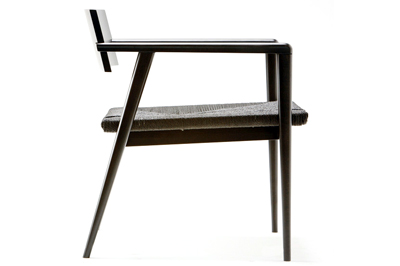
The Dormitio Lounge Chair was designed in the fifties for those returning, wearily, from the Benedictine abbey of San Pietro – Civate, Italy.
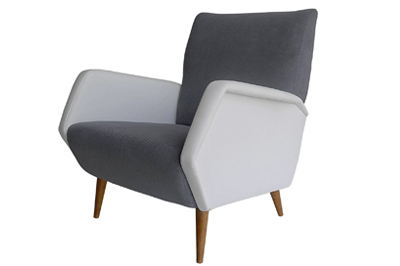
Armchair Model 803 from Ponti’s Mid-Century upholstered series, Italy, 1954 with walnut legs and wool upholstery.
Poul Volther was a Danish furniture designer who is remembered above all for his iconic Corona Chair.

The Corona Chair: one of the most recognizable designs of the twentieth century, still both chic and comfortable. An excellent example from the original production run.

Handsome Danish Modern Oak Daybed by Poul Volther. Features slatted oak frame and newly upholstered cushion.

Italian product designer Joe Colombo (1930-1971) produced a series of innovations which made him one of Italy’s most influential product designers of his time. The first chair he designed in 1963 was the Elda armchair, named after his wife. It is made out of fiberglass. It was created for the italian manufacturer comfort.

These lamps designed in 1967 for Kartell. These lamps can be stacked together, or have them side by side.
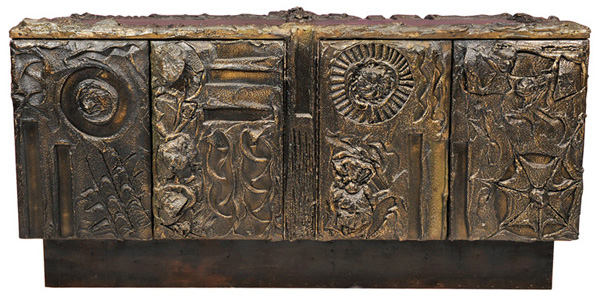
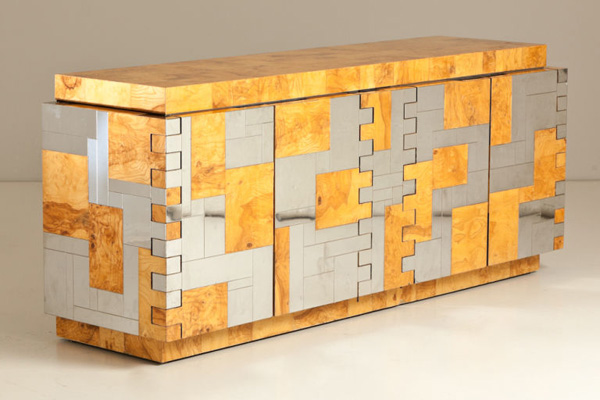
Paul Evans was a leading designer in the Mid Century American studio and brutalist furniture movement. Evans consistently push boundaries with his innovative approaches to sculptures. Evans applied these same aesthetic principles to furniture, creating chunky, deeply textural works of art that masqueraded as utilitarian objects. He produced several lines for the manufacturer Directional, the most well known of which is probably his Cityscape series, which comprised a range of furniture sheathed in a sleek patchwork of metal, mirror, and wood.

Erwine and Estelle Laverne: Erwine (1909-2003) and Estelle (1915-1997) Laverne both trained as painters at the Art Student’s League under Hans Hofmann. In the 1930s they pooled their collective talent and focus into design, establishing Laverne Originals in 1938, an influential New York company driven by their precise and unique modern artistic style.
In 1957 Erwine and Estelle Laverne came out with their “Invisible Group” of curvy see-through plastic furniture designed to exist in a space as, Erwine believed, “an element of contrast to eliminate sameness.” The molded perspex seats and lean, fluted bases were reminiscent of Saarinen’s “Tulip” chair, and the names of some of these Laverne pieces, like “Daffodil,” “Lily” and “Jonquil,” resonated obviously with their inspiration.