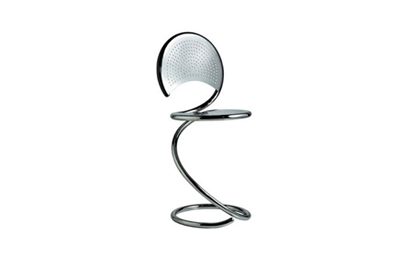
Poul Henningsen (1894-1967), or better known as PH, has become synonymous with Danish lighting design. However, even though he’s well known for lighting designs, he made an early move into furniture with the Spiral chair (1932), and the results were equally innovative and chic.

Poul Henningsen Artichoke Lamp designed for Louis Poulsen Lighting (1958), is composed of layers of overlapping ‘leaves’ that produce crisp, glare-free 360-degree light. He once said, “It doesn’t cost money to light a room correctly, but it does require culture”.
Like almost all the modernists in Los Angeles in the 1920s, Kem Weber was a transplant to the city. He was born Karl Emanuel Martin Weber (in his twenties, he began using his initials as his first name) in Berlin in 1889. After serving as an apprentice cabinetmaker in his teens, he studied architecture and interior design with Bruno Paul at the School of Applied Arts (Kunstgewerbeschule) in Berlin and later worked in Paul’s architectural office.

In the early summer of 1914, he traveled to San Francisco to supervise the building of the German Pavilion for the Panama-Pacific International Exposition, but when the war erupted in Europe in August, he found himself stranded in the United States. Seeing greater opportunity in the New World, Weber stayed in the United States after the war ended, later becoming a U. S. citizen in 1924.


Born in La Spezia, Italy, in 1939, Gaetano Pesce studied Architecture at the University of Venice between 1958 to 1963 and was a participant in Gruppo N, an early collective concerned with programmed art patterned after the Bauhaus. In the “Nobody’s Royal” queen armchair made by Zerodesegno. A unique piece signed and dated. The body is composed of three panels handmade of polyurethane resins held together with black nylon pins.

Nobody is perfect, very unique piece on this collection of antiques.

Eva Zeisel (Nov 1906-Dec 2011), called a “maker of good things”, was an American industrial designer known for her work with ceramics. Her designs are often abstractions of the natural world and human relationships. These Red Wing Town and Country Salt and Pepper shakers show her creativity.

Her elegant, eccentric designs in the 1940s and ‘50s helped to revolutionize the way Americans decorate their homes.
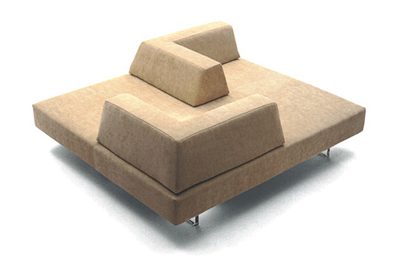
Vladimir Kagan is one of our most enduring designers of modern furniture with a career that has spanned over sixty years.

He started designing in 1946 and by the early fifties, his innovative sculptured designs created a new look in American furniture. This Cabinet is a spectacular early Vladimir Kagan design for Grosfeld House in walnut and cane.
Karl Springer was one of the greatest contemporary furniture stylists of the 20th century. His unique blending of sophistication and crudeness made his work the most imitated during the 1970s and 1980s. One can still sense his influence in contemporary furniture now being produced.
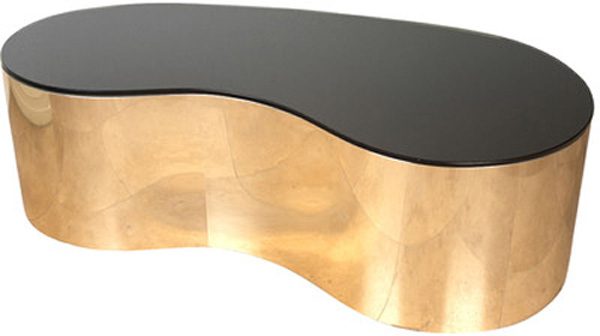
He worked with many exotic materials to translate pure, classical shapes into contemporary, custom-made furniture, light fixtures or Venetian-glass objects.